Vintage and Charity Shops in Edinburgh: The Best Thrifting Streets (2026)
Edinburgh is one of the best cities in Britain for secondhand clothes and it is comprehensively under-documented. The competition for this search is a YouTube shop tour and a blog post from 2016, which is remarkable for a city with a two-hundred-year-old vintage trade, forty thousand students churning wardrobes twice a year, and some of the wealthiest charity-shop catchments in Scotland.
The organising principle here is walkable clusters, because that is how you actually shop secondhand: four or five shops within ten minutes of each other, worked through in an afternoon. This guide covers the four clusters worth your time, what each is genuinely good for, which days to go, and honest price expectations — because “vintage” in Edinburgh spans a £3 charity-shop jumper and a £300 Chanel jacket, and the two are two streets apart.
At a Glance
- W. Armstrong & Son, established 1840 — one of the oldest vintage clothing businesses in the UK. Branches at 83 Grassmarket, 14 Teviot Place and 66 Clerk Street.
- Four clusters: the Grassmarket and West Port; Stockbridge; the Southside around Nicolson Street and Clerk Street; and Leith Walk.
- Herman Brown, trading since 1983, on the West Port. Mainly womenswear.
- Carnivàle Vintage — womenswear and menswear spanning the 1890s to 1990s, specialising in 1940s to 1970s pieces.
- Those Were The Days, a basement on St Stephen Street in Stockbridge, has stocked Chanel, Versace and Givenchy.
- The Edinburgh Flea Market runs on the last Saturday of most months, 10:00–15:00, at the Drill Hall in Leith. Indoors, and closed in December.
- Best days: weekday mornings for charity shops (donations are sorted overnight), Saturday for the dedicated vintage shops, and the last Saturday of the month for the flea market.
- Best months: late June and early September, when the student population turns over and Stockbridge and the Southside fill up.
- Realistic prices: £3–£12 in charity shops; £20–£60 for ordinary curated vintage; £80–£300+ for designer or genuinely rare pieces.
- Scotland has no Sunday trading restrictions, so shops keep normal hours on a Sunday — unlike large shops in England.
Cluster One: the Grassmarket, West Port and Victoria Street
The obvious one, the densest, and the right place to start. Everything here is within about eight minutes’ walk, in the Old Town below the castle.
W. Armstrong & Son, 83 Grassmarket
The flagship of a business established in 1840, which makes it one of the oldest vintage clothing operations in the United Kingdom and considerably older than most of what it sells. The Grassmarket shop is the big one — a red-fronted, densely packed warren spanning the decades, from 1920s eveningwear through to 1970s platforms and a substantial costume and formalwear section.
Armstrong’s has other branches at 14 Teviot Place, by the university and Bristo Square, and 66 Clerk Street in the Southside, plus a sister store, The Rusty Zip. Sources disagree on whether the group runs three shops or four, so treat the count as approximate — the three addresses above are the ones that check out.
The honest verdict: Armstrong’s is a genuine institution and it is also the most expensive vintage in the city, because it knows exactly what it has. It is superb for costume, for statement pieces, and for anyone who wants to be certain a 1960s coat is actually from the 1960s. It is not where you find a bargain. Go for the browse and the building; go elsewhere for value.
Herman Brown, West Port
Trading since 1983, on the West Port at the far end of the Grassmarket. Mainly womenswear, tightly curated rather than piled high, with a smaller menswear section that is still worth ten minutes. This is the shop for people who find Armstrong’s overwhelming — one buyer’s taste, applied consistently, over four decades.
Godiva
Hand-picked vintage alongside pieces by ethical, local and independent designers, which makes it the crossover shop — half secondhand, half contemporary small-label. Good if you want something nobody else will have and are not fussed about whether it is old.
Carnivàle Vintage
An unusually deep collection: womenswear and menswear spanning the 1890s to the 1990s, with a specialism in 1940s to 1970s pieces. The range back into the nineteenth century is what distinguishes it — most “vintage” shops in Britain start at about 1950.
A note on addresses: Armstrong’s is given with street numbers; Herman Brown, Godiva, Carnivàle and Those Were The Days are given by street only. Small independents move, and the West Port and Grassmarket are both short enough to walk end to end in five minutes.
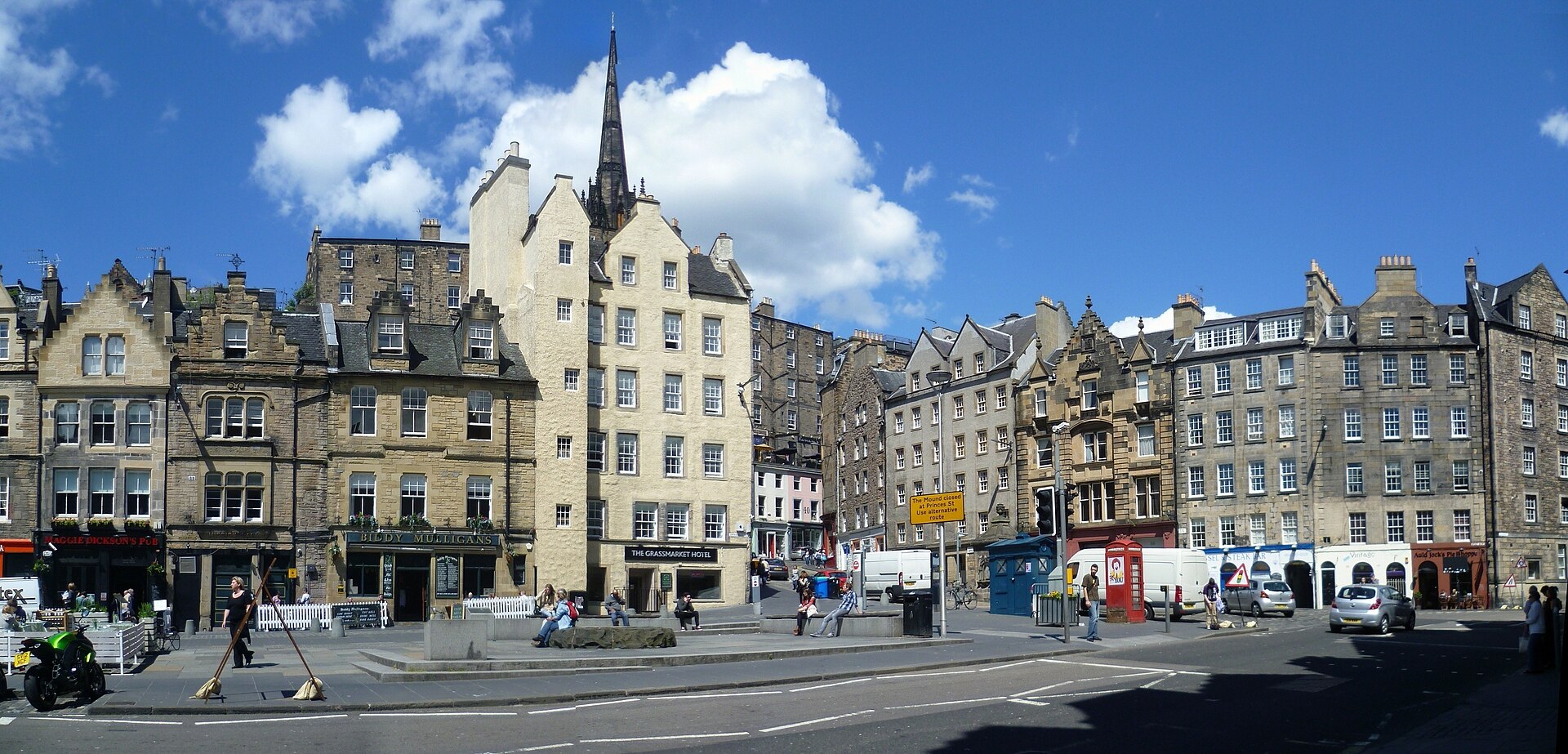
Time it right: the Grassmarket Market runs here every Saturday 10:00 to 17:00, so a Saturday gives you the shops and a market in one square. Our Grassmarket area guide covers the rest of it, and our Edinburgh markets guide has the day-by-day timings.
Cluster Two: Stockbridge — Where the Charity Shops Are Good
This is the cluster that experienced secondhand shoppers rate above the Grassmarket, and the reason is unglamorous: charity shops are only as good as the neighbourhoods that donate to them, and Stockbridge is a wealthy, settled, densely populated part of Edinburgh where people buy good clothes and give them away.
The run is Raeburn Place, St Stephen Street and the streets between, about twenty minutes’ walk downhill from Princes Street. Within a few hundred metres you get a concentration of charity shops — several of them the specialist “boutique” branches that the big charities put in affluent areas — alongside genuine vintage.
Those Were The Days, St Stephen Street
A tiny basement shop on St Stephen Street that has stocked Chanel, Versace and Givenchy. It is small, it is stuffed, and it is the single most likely place in Edinburgh to find something genuinely extraordinary. Prices reflect that; this is not thrifting, it is second-hand luxury.
The charity shop run
Work Raeburn Place and then St Stephen Street. Go on a weekday morning: donations come in at weekends, get sorted early in the week, and reach the floor before the weekend rush. Tuesday and Wednesday mornings are the sweet spot and the difference is real, not folklore.
The honest verdict on Stockbridge: the best value in the city and the least atmospheric hunting. You are working through ordinary charity shops in an ordinary shopping street, not browsing a curated rail, and you will look at a hundred bad jumpers to find one good coat. If that is your idea of a good afternoon, this is the best cluster in Edinburgh. If it is not, go to the Grassmarket and pay for the curation.
Two useful things: Stockbridge Market runs every Sunday 10:00 to 16:00 on Saunders Street, and Golden Hare Books at 68 St Stephen Street opens every day 10:00–18:00 — UK Independent Bookshop of the Year in 2019, and a good place to end. See our Stockbridge area guide.
Cluster Three: the Southside — Nicolson Street and Clerk Street
The student cluster, and the one with the best turnover. Nicolson Street runs south from South Bridge and becomes Clerk Street, and the whole corridor sits between the university and the tenement flats that house most of its students.
Armstrong’s at 66 Clerk Street anchors it, and 14 Teviot Place — a quieter, more boutique branch near Bristo Square — is a few minutes west. Around them is a run of charity shops that behave completely differently from Stockbridge’s: less designer, far more volume, and dramatically more interesting at two points in the year.
The timing that matters: Edinburgh’s student population turns over in late June, when leases end and people clear flats before flying home, and again in early September when the same thing happens in reverse. In those two windows the Southside charity shops receive a volume of donations they cannot process, and the racks are extraordinary. This is the single best-kept piece of secondhand knowledge in the city.
Add Surgeons’ Hall Museums and the Festival Theatre, both on Nicolson Street, and the National Museum of Scotland five minutes away and free, and the Southside is a proper afternoon rather than a shopping detour. See our Newington and the Southside guide.
Cluster Four: Leith Walk and Leith
The least polished cluster and the one where the genuine bargains are, because it has not yet been fully priced up. Leith Walk runs about a mile and a half from the top of Leith Street down to the Foot of the Walk, and there is a scatter of secondhand shops, house-clearance places and charity shops along it.
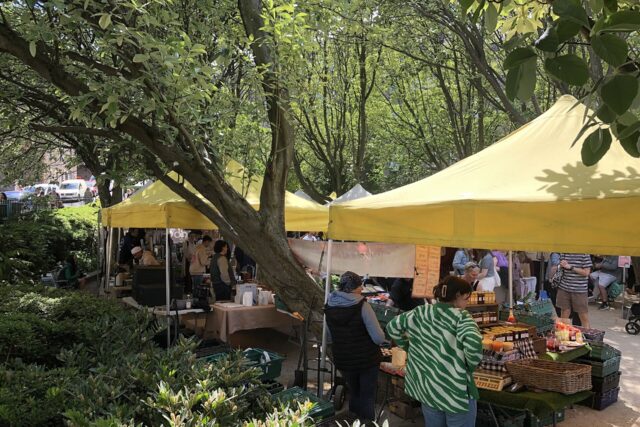
The fixed point is the Edinburgh Flea Market: last Saturday of most months, 10:00 to 15:00, at the Drill Hall in Leith, with no market in December. It is indoors — which in Edinburgh is a serious advantage — and it covers clothing, records, furniture, and the general bric-a-brac that clothing-only vintage shops do not touch.
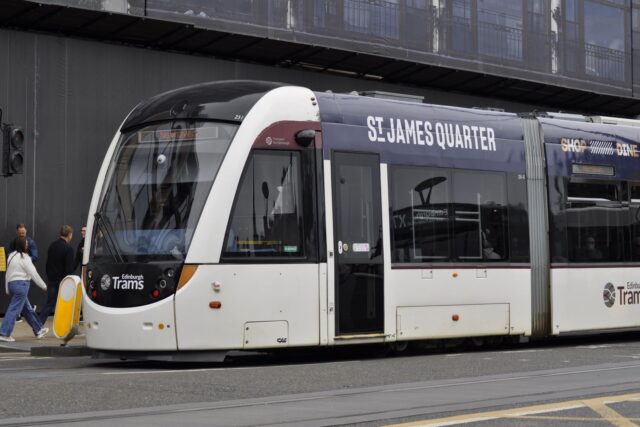
The honest verdict on Leith Walk: walking it is not enjoyable. The top half is a busy arterial road with roadworks scars, betting shops and traffic, and it does not become pleasant until roughly Pilrig. Take the tram to Foot of the Walk or The Shore and work back up, rather than starting at the top and grinding down. The Leith and The Shore guide covers the good end.
Realistic Prices
| What | Where | Expect to pay |
|---|---|---|
| Everyday jumper, shirt or dress | Charity shops, Stockbridge or Southside | £3–£12 |
| Good wool coat, secondhand | Charity shops | £15–£40 |
| Curated vintage dress or shirt | Armstrong’s, Herman Brown, Godiva | £20–£60 |
| 1960s or 1970s statement coat | Armstrong’s, Carnivàle | £60–£150 |
| Genuine designer piece | Those Were The Days; charity boutiques | £80–£300+ |
| Records, bric-a-brac, small furniture | Edinburgh Flea Market | £2–£40 |
The honest verdict on “vintage” pricing generally: the word has been doing a lot of work in British retail for about fifteen years, and in Edinburgh it now covers everything from a genuinely rare 1940s piece to a 2009 high-street dress on a nice rail. Curation is a real service and it is legitimate to pay for it. What is not legitimate is a £45 price tag on something that was £8 in a charity shop last week and has had nothing done to it. If you cannot tell, ask what decade it is from — a shop that knows will tell you, and a shop that does not is reselling.
What Edinburgh Is Actually Good For
Every secondhand city has specialisms determined by what its residents historically wore. Edinburgh’s are unusually distinct, and knowing them turns an aimless browse into a targeted hunt.
- Tweed jackets. The best thing to look for here, by a distance. Scotland has worn tweed for two centuries, the jackets last forever, and a good secondhand Harris Tweed jacket turns up regularly at £20 to £45 in charity shops — against several hundred new. Check the label for the Orb mark and check the lining, which is what fails first.
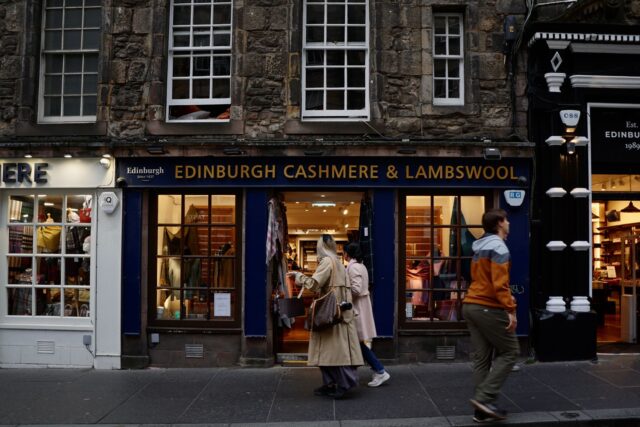
- Knitwear. Scottish lambswool and cashmere both appear constantly in Stockbridge and Morningside charity shops, often barely worn. This is the single best-value way to buy Scottish knitwear, and it is a fraction of what our guide to buying cashmere and tweed new describes.
- Kilts and Highland dress. Genuinely available secondhand, and much cheaper than the several hundred pounds a new one costs — but the sizing problem is severe, since a kilt fits one waist and one length. Worth checking if you are close to a standard size; see where to buy a kilt in Edinburgh for what the new version costs.
- Costume and formalwear. Armstrong’s exists partly to dress the Fringe, which means an unusually deep stock of period costume, evening dress and things nobody would wear to work.
- Books and records. A university city with a long literary trade produces good secondhand books, and the flea market and the Southside shops are where they surface. See Edinburgh’s bookshops and literary cafés.
- Waterproofs and boots. An outdoors-going population donates a great deal of barely used walking gear. If the weather has caught you out, a charity shop is cheaper and faster than an outdoor retailer.
The honest verdict: if you buy one secondhand thing in Edinburgh, make it a tweed jacket. It is the category where the city’s supply is deepest, the quality is highest, the sizing is most forgiving, and the gap between the secondhand and new price is widest. Everything else on this list is a bonus.
When to Go
- Tuesday and Wednesday mornings — the best charity-shop hours of the week. Weekend donations have been sorted and are hitting the floor.
- Saturday — for the dedicated vintage shops, which are fully staffed and open latest, plus the Grassmarket Market 10:00–17:00.
- Last Saturday of the month — the Edinburgh Flea Market (not in December), 10:00–15:00, Drill Hall, Leith. Indoors.
- Sunday — Stockbridge Market plus the St Stephen Street shops. Scotland has no Sunday trading restrictions, so hours are normal.
- Late June and early September — the two student turnover windows, when the Southside charity shops are at their best.
- Avoid August if you can. The Fringe fills every shop in the Old Town with people who are not shopping, and Armstrong’s in particular becomes a costume department for the entire festival.
A Practical Afternoon
- 10:00 — start in Stockbridge on Raeburn Place, working the charity shops while they are freshly stocked.
- 11:30 — St Stephen Street, including Those Were The Days, and Golden Hare Books at number 68.
- 13:00 — lunch in Stockbridge, then walk or take the bus up into town.
- 14:30 — the Grassmarket: Armstrong’s at 83, then the West Port for Herman Brown and the rest.
- 16:30 — up Victoria Street for the independents, and finish there.
That is a full day of secondhand shopping across two of the four clusters, on foot, for the price of one bus fare. Our guide to Edinburgh on a budget and the student guide to Edinburgh both cover the wider version of this.
Practical Notes
- Sizing. Vintage sizing is not modern sizing and the drift is large — a vintage 14 is roughly a modern 10. Ignore the label and use the measurements, or try it on.
- Changing rooms are limited in small vintage shops and sometimes absent in charity shops. Wear something you can layer over.
- Check under the arms and at the seams for perished fabric, and look at zips and buttons — these are the repairs that cost more than the garment.
- Payment: almost everywhere takes cards now, but a small independent basement shop is exactly where that fails. Carry some cash.
- Getting it home: a wool coat is heavy. If you are flying with hand luggage only, wear it — Edinburgh will give you the weather for it.
- No VAT refund. The scheme was abolished in 2021, and secondhand goods would not have qualified anyway.
Shop histories, the Armstrong’s addresses and the flea market timings were checked in October 2026. Small shops move, and all four clusters are walkable end to end in a few minutes.
Frequently Asked Questions
Where are the best vintage shops Edinburgh has?
The Grassmarket and West Port cluster is the densest: W. Armstrong & Son at 83 Grassmarket, established 1840, plus Herman Brown, Godiva and Carnivàle Vintage within a few minutes’ walk. Stockbridge has the best charity shops and Those Were The Days on St Stephen Street, and the Southside around Clerk Street has the highest turnover.
What day is best for charity shops in Edinburgh?
Tuesday and Wednesday mornings. Donations arrive at weekends, get sorted early in the week and reach the racks before the weekend crowds. The difference is real rather than folklore, and it applies particularly in Stockbridge, where the donations are worth getting to first.
How old is Armstrong’s vintage in Edinburgh?
W. Armstrong & Son was established in 1840, making it one of the oldest vintage clothing businesses in the United Kingdom. The flagship is at 83 Grassmarket, with further branches at 14 Teviot Place near the university and 66 Clerk Street in the Southside, plus a sister store, The Rusty Zip.
Is there a flea market in Edinburgh?
Yes — the Edinburgh Flea Market, on the last Saturday of most months from 10:00 to 15:00 at the Drill Hall in Leith, with no market in December. It is indoors, which matters in this city, and it covers clothing, records, furniture and general bric-a-brac rather than clothes alone.
How much does vintage clothing cost in Edinburgh?
Charity shops run £3 to £12 for everyday items and £15 to £40 for a good wool coat. Curated vintage shops charge £20 to £60 for a dress or shirt and £60 to £150 for a statement piece from the 1960s or 1970s. Genuine designer pieces at somewhere like Those Were The Days run from £80 into the hundreds.
When is the best time of year for secondhand shopping in Edinburgh?
Late June and early September, when Edinburgh’s large student population turns over and clears flats. The Southside charity shops in particular receive more donations in those windows than they can process. Avoid August, when the Fringe fills the Old Town shops with people who are not shopping.
Does vintage sizing match modern sizing?
No, and the gap is large. A vintage size 14 is roughly a modern 10, and the drift increases the further back you go. Ignore the label entirely, use the garment’s measurements, and try things on — which means wearing something you can layer over, since changing rooms in small shops are limited.
Are Edinburgh’s shops open on Sundays?
Yes, and on normal hours. Scotland has no equivalent of England’s Sunday trading restrictions, so large shops are not limited to six hours the way they are south of the border. Stockbridge on a Sunday combines the market on Saunders Street from 10:00 to 16:00 with the St Stephen Street shops.
Where to Go Next
See our complete guide to shopping in Edinburgh for the wider retail picture, and Edinburgh’s markets by day for timing an afternoon around the flea market or the Grassmarket. For the neighbourhoods, see the Grassmarket, Stockbridge and Newington and the Southside. If you are doing Edinburgh cheaply, free things to do in Edinburgh pairs well with a secondhand afternoon.
More Edinburgh Shopping Guides
Photo Credits
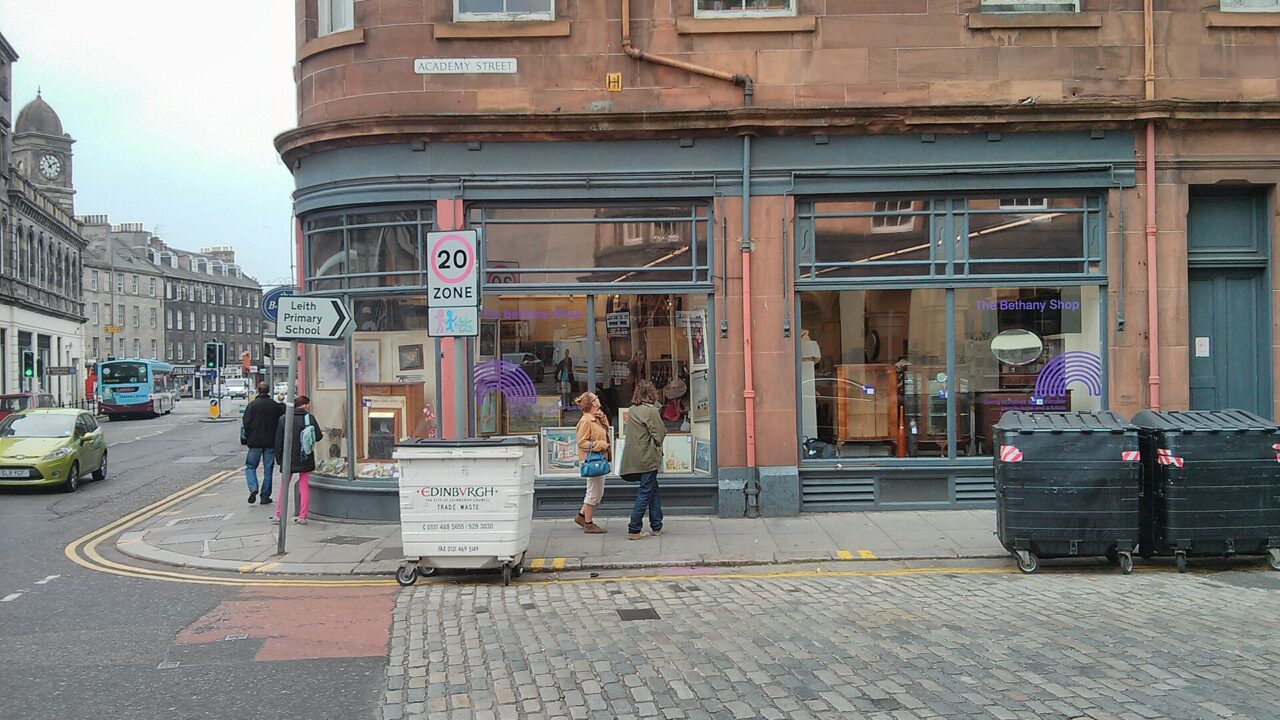
The Bethany Shop in Leith: Bethany duke st by Victuallers, CC BY-SA 1.0, via Wikimedia Commons.
The eastern end of the Grassmarket: East end of the Grassmarket, Edinburgh (composite) by Kim Traynor, CC BY-SA 3.0, via Wikimedia Commons.