Cashmere, Tweed and Knitwear in Edinburgh: Where to Buy the Real Thing (2026)
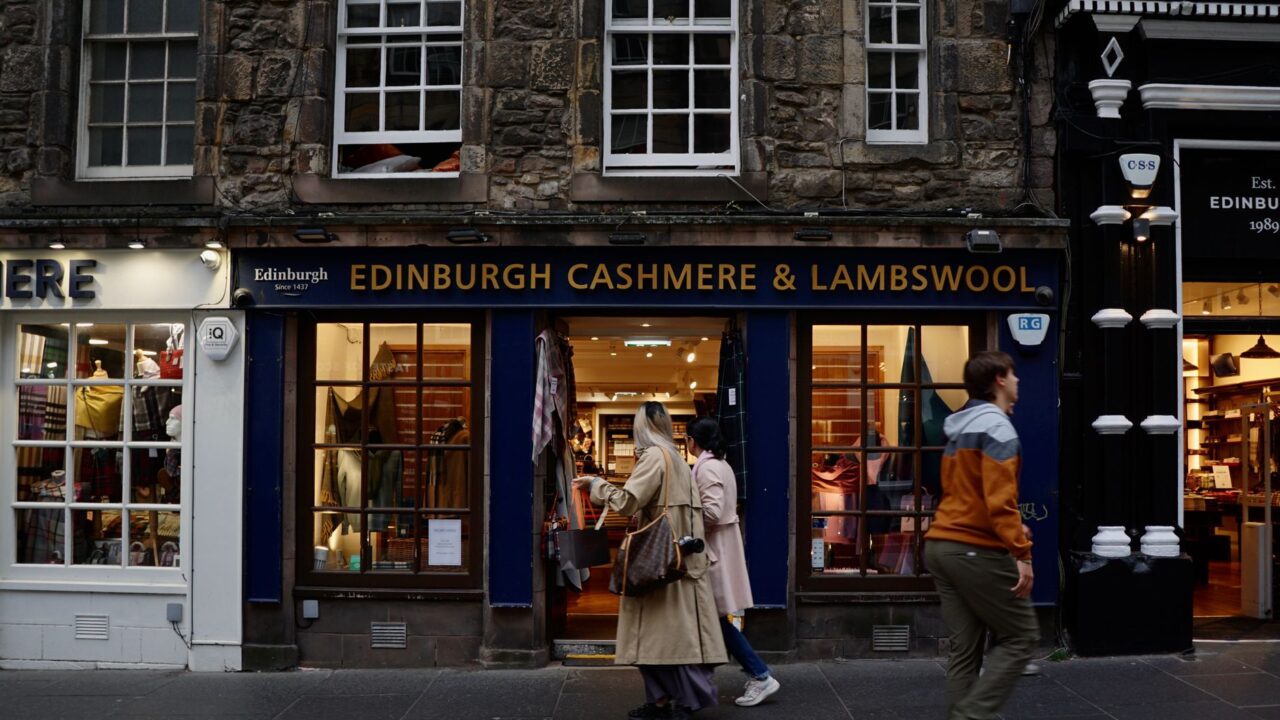
Walk the Royal Mile and you will pass twenty shops with CASHMERE in the window. Most of them are selling the same thing at the same price, and it is not what a Scottish cashmere scarf costs. The industry that made this country’s name in wool is real, still working, and almost entirely absent from the streets where visitors shop.
This guide is the quality ladder: which shops are mill brands, which are retailers, which are tourist stock; how to read a cashmere label and what price actually indicates; and the one fabric with a law behind it, which is the easiest good decision anyone can make in Edinburgh. Addresses and hours were taken from the shops’ own sites in October 2026.

At a Glance
- Johnstons of Elgin, 11 Multrees Walk, EH1 3DQ. Mon–Sat 10:00–18:00, Sunday 11:00–17:00. Founded 1797; one of Scotland’s last vertical mills at Elgin plus a knitting mill at Hawick. Personal shopping appointments on request.
- Stewart Christie & Co, 63 Queen Street, EH2 4NA — a tailor with a heritage dating to about 1720. Harris Tweed, its own estate tweeds, and Highland dress.
- Harris Tweed is protected by an Act of Parliament. Handwoven by islanders at their own homes in the Outer Hebrides from pure virgin wool dyed and spun there. The proof is the Orb mark.
- Brora — founded 1993 by Victoria Stapleton, named after the Highland village and the tweed mill her family ran there; its cashmere is made at a historic Scottish Borders mill.
- Vertical mill is the term to know: one company doing everything from raw fibre to finished garment. Very few remain.
- A real Scottish cashmere scarf is a serious purchase and a good jumper more so. A scarf priced like a fridge magnet is not what the label says it is in any meaningful sense.
- Lambswool is the value buy, not cashmere. A Scottish-spun lambswool jumper is warmer, tougher and a third of the price.
- There is no VAT refund for visitors. Abolished in 2021. The only route is having the shop ship to a non-UK address.
- Multrees Walk is where the best of it is concentrated, two minutes from St Andrew Square.
The Quality Ladder
Every wool purchase in Edinburgh sits on one of four rungs, and knowing which one you are on is most of the battle.
| Rung | What it is | How to spot it |
|---|---|---|
| 1. Mill brands | Companies that spin and weave their own cloth in Scotland | Names a mill and a town. Johnstons of Elgin is the clearest example. |
| 2. Scottish heritage brands | Design here, manufacture at named Scottish and overseas mills | Can tell you where a specific garment was made if you ask |
| 3. Independent retailers | Shops buying good stock from several makers | Staff who can name suppliers; no fridge magnets |
| 4. Tourist stock | Wholesaled goods, often imported, sold on location | Also sells keyrings, whisky miniatures and printed t-shirts |
The honest verdict: rung four is not a fraud. A £20 acrylic-blend scarf will keep your neck warm and nobody is lying to you about very much. What it is not is a Scottish textile, and if the point of the purchase is to bring home something made here, it fails on the only criterion that mattered. Decide which purchase you are making before you walk in.
Johnstons of Elgin: the Benchmark
11 Multrees Walk, EH1 3DQ. Monday to Saturday 10:00–18:00, Sunday 11:00–17:00.
Founded in 1797 and still family-controlled, Johnstons is the company against which everything else here should be measured, for one structural reason: it is a vertical mill. It takes in raw fibre and puts out finished garments, doing the dyeing, blending, spinning, weaving and finishing itself at Elgin in Moray, with a separate knitting mill at Hawick in the Borders. Almost nobody else in Britain still does this.
Why it matters to a buyer: vertical means the company can tell you exactly what is in a garment and where every stage happened, because it did all of them. That is a different kind of claim from “designed in Scotland”.
The Edinburgh store carries men’s and women’s clothing and accessories plus the home interiors collections — throws, blankets, cushions. There is no café and no made-to-measure here, but personal shopping appointments are available if you contact the store, which is worth doing if you are making a serious purchase and want time rather than a Saturday scrum.
The honest verdict: this is not cheap and it is not meant to be. A Johnstons scarf is roughly five times a Royal Mile scarf, and it is the difference between a souvenir and an object you will still own in twenty years. If you are going to buy one Scottish textile on your trip, buy it here and buy it once. If your budget will not stretch, buy Scottish-spun lambswool instead of cheap cashmere — see below.
How to Read a Cashmere Label
“100% cashmere” is a statement about fibre content, not about quality, and it is the single most misunderstood label in retail. Two garments can both be honestly labelled 100% cashmere and be entirely different products.
- Fibre length. Long fibres make a fabric that resists pilling; short fibres pill within weeks. Both are cashmere. Price is the only reliable proxy a shopper has.
- Ply. Two-ply is the sensible minimum for a jumper. Single-ply is thin, light and short-lived.
- Weight. Pick it up. A good cashmere scarf has heft; the cheap version is oddly weightless.
- The stretch test. Pull gently across the knit and let go. Good cashmere springs back; poor cashmere stays stretched.
- The rub test. Rub a patch briskly between finger and thumb for a few seconds. If little balls form immediately, it will pill on your shoulder in a fortnight.
- Ask where it was spun. A shop selling mill goods answers instantly. A shop selling wholesale stock changes the subject.
The honest verdict on price: raw cashmere is expensive because a goat produces a very small amount of usable undercoat each year, and the processing is slow. A scarf that has been through that supply chain, been spun in Scotland and been finished properly cannot retail at £15 and leave anyone a margin. When the price is impossible, something in the chain has been substituted — usually fibre length, usually invisibly.
Harris Tweed and the Orb
If cashmere is the category where you can be quietly misled, Harris Tweed is the category where you cannot, because it is the only fabric in the world protected by its own Act of Parliament.
To be Harris Tweed, cloth must be handwoven by islanders at their own homes in the Outer Hebrides, from pure virgin wool that has been dyed and spun in the Outer Hebrides. Not woven in a factory. Not woven on the mainland. Woven at home, on the islands, by hand, by a person.
The proof is the Orb mark, a stamped trademark applied by the Harris Tweed Authority after inspection. On finished garments it appears on a label. If a shop cannot show you the Orb, the cloth is not Harris Tweed, whatever the shelf-talker says.
Where to buy it in Edinburgh
- Stewart Christie & Co, 63 Queen Street, EH2 4NA. A tailor with a heritage dating to about 1720, carrying Harris Tweed alongside its own estate tweeds. This is where to go for a jacket rather than an accessory, and where the staff will talk to you about cloth weight for as long as you want.
- Islander, Victoria Street. Harris Tweed specialists in the Old Town, and the easiest place to buy a cap, a bag or a small accessory without a New Town budget.
- Museum shops — the National Museum of Scotland carries tweed accessories, and the buying is good.
The honest verdict: a Harris Tweed cap or bag is the best-value textile purchase available in Edinburgh, and it beats cashmere on every axis except softness. It is genuinely handwoven by a named category of person in a named place, it is legally protected against imitation, it is close to indestructible, and it costs less than a mediocre cashmere scarf. Prices vary by shop, so check the price tag, but if you want one thing made in Scotland on a modest budget, buy Harris Tweed.
The Underrated Answer: Lambswool
Nobody recommends lambswool, because it does not sound luxurious, and it is the best-value thing in this article after Harris Tweed.
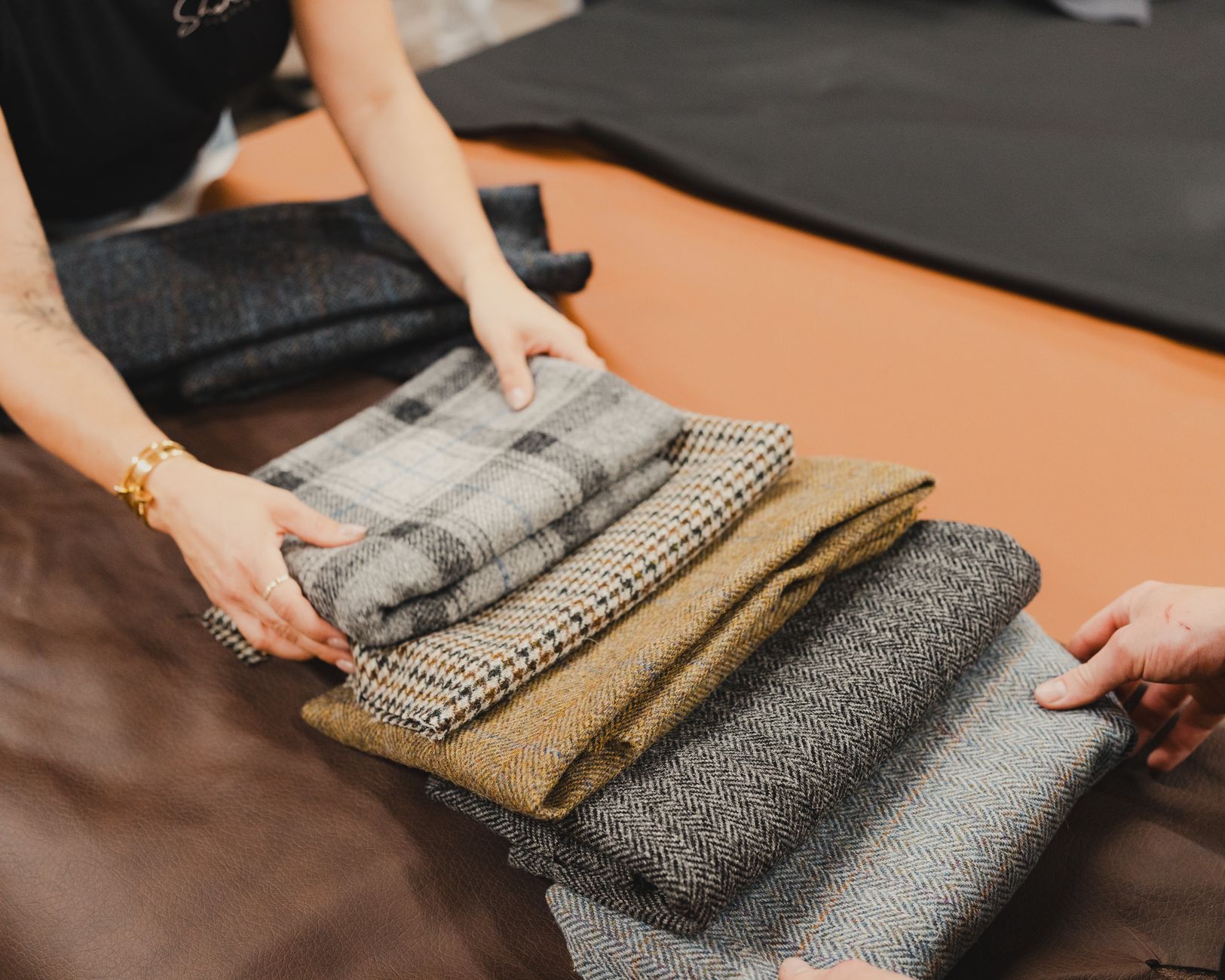
Scottish lambswool — spun in the Borders, knitted in Hawick and its neighbours — is warmer than cashmere for the same weight, dramatically more hard-wearing, holds its shape better, and costs roughly a third as much. It is what people who live in Scotland actually wear. Cashmere is softer against the skin and that is essentially the whole of its advantage.
The honest verdict: if your budget is £60, a good Scottish lambswool jumper is a far better object than a cheap cashmere one, and it will outlast it by a decade. The cashmere marketing is stronger; the wool is better. Ask specifically for Scottish-spun lambswool and see what a shop produces — it is a useful test of whether you are in a real shop.
Brora, Anta and the Heritage Brands
Brora was founded in 1993 by Victoria Stapleton, named for the Highland village of Brora and the tweed mill her family ran there. Its cashmere is made at a historic Scottish Borders mill. The aesthetic is bright colour and pattern rather than the classics, and it is the brand most likely to produce something you would not find at Johnstons.
Anta works in tartan and tweed for interiors as much as clothing — throws, blankets, cushions, ceramics — in a distinctive muted palette. Anta has a shop at 169 Rose Street, EH2 4LS, open daily from 11:00 to 17:00. For Brora, check its store page for the current Edinburgh shop before you set out. Both are worth the detour.
The same caution applies to Kinloch Anderson, which has been making Highland dress in Edinburgh since 1868 and works substantially in wool and tweed. Its own site lists its kilt from £775, and prices vary with tartan and cloth, so see our guide to where to buy a kilt in Edinburgh for the Highland-dress side of the same trade.
Where to Shop, Street by Street
- Multrees Walk — the pedestrian lane linking St Andrew Square to St James Quarter. Johnstons of Elgin at number 11, plus Scotland’s only Harvey Nichols and only Louis Vuitton, Mulberry, Burberry and Max Mara. A cluster of serious clothing brands along one short pedestrian stretch.
- Queen Street — Stewart Christie at 63, in a quiet Georgian terrace two streets north of Princes Street.
- Thistle Street and William Street — the New Town independents. Jane Davidson and Pam Jenkins have both been named by Vogue among Britain’s best boutiques; William Street has Arkangel & Felon and the shoe designer Helen Bateman. See our West End guide.
- Victoria Street — Islander for Harris Tweed, in the Old Town, two minutes from the Royal Mile and a completely different quality of shop from it. See our Victoria Street guide.
- Stockbridge — St Stephen Street and Raeburn Place for secondhand and vintage knitwear, and the Sunday market. Genuinely good hunting if you are patient. See our Stockbridge guide.
- The Royal Mile — rung four. Fine for a warm scarf; not where the Scottish textile industry lives.
A Note on Hawick, and Whether to Chase the Mills
Sooner or later someone will tell you that the real bargains are at the mill shops in the Borders, and specifically at Hawick, the knitwear town an hour and a half south of Edinburgh where a great deal of Scotland’s cashmere has been knitted for two centuries. Johnstons runs its knitting operation there; so, historically, did most of the famous names.
The honest verdict on the mill-shop pilgrimage: it is a real thing and it is usually not worth a visitor’s day. The savings on a single scarf will not cover the fare, the industry has consolidated sharply and several of the shops people remember have closed, and you will spend six hours of a short trip travelling to a working Borders town to buy a garment that the Edinburgh store also stocks. Go if you want to see the Borders — the drive through Peebles and the Tweed valley is genuinely lovely — and treat any bargain as a bonus rather than the reason.
What is worth knowing is why the industry ended up there at all. The Borders mill towns sit on fast rivers, which drove the machinery, and in sheep country, which supplied the fibre. The cashmere arrived later, imported from Central Asia and processed here because Scotland had the water, the spinning expertise and the finishing skill — which is why “Scottish cashmere” means Scottish-processed rather than Scottish-grown, and why nobody in the trade pretends otherwise.
That distinction is worth carrying into a shop. A seller who explains that the fibre comes from Mongolia and the spinning happens in the Borders is telling you the truth and knows their supply chain. A seller who implies the goats are Scottish does not.
Buying, Shipping and Caring for It
VAT. There is no visitor VAT refund anywhere in Great Britain — the Retail Export Scheme was abolished in 2021 and there is no refund desk at Edinburgh Airport. The only remaining route to a tax-free purchase is having the retailer ship directly to a non-UK address, which is treated as an export. The better shops will do this on a significant purchase; ask before you pay rather than after.
VAT is already in the price. Nothing is added at the till. The number on the label is the number you pay.
Care. Hand wash cashmere in cool water with a wool detergent, never wring it, dry it flat, and never hang it — the weight of wet cashmere stretches the shoulders permanently. Use a cashmere comb rather than a razor for pills. Store folded, with cedar rather than mothballs. Done properly, a good scarf lasts decades; done badly, it is ruined in one wash.
Packing. Knitwear compresses well and is the one purchase that genuinely improves your luggage situation — see our guide to what to pack for Edinburgh, which also explains why you will probably want the scarf before you get home.

Addresses, hours and company histories checked against the shops’ own websites in October 2026. Prices are indicative ranges, not quotes.
Frequently Asked Questions
Where to buy cashmere in Edinburgh?
Johnstons of Elgin at 11 Multrees Walk, EH1 3DQ, open Monday to Saturday 10:00–18:00 and Sunday 11:00–17:00. Founded in 1797, it is one of Scotland’s last vertical mills — spinning and weaving its own cloth at Elgin and knitting at Hawick — which means it can tell you exactly where every stage of a garment happened. Personal shopping appointments are available on request.
How much should a real cashmere scarf cost?
Considerably more than tourist-shop stock for a Scottish mill-brand scarf, and more again for a jumper. Raw cashmere is expensive because each goat yields a small amount of usable undercoat annually. A very cheap scarf may be honestly labelled as to fibre content but something in the supply chain has been substituted — usually fibre length, which shows up as pilling within weeks.
How do I tell if Harris Tweed is genuine?
Look for the Orb mark, applied by the Harris Tweed Authority after inspection. Genuine Harris Tweed must by law be handwoven by islanders at their own homes in the Outer Hebrides from pure virgin wool dyed and spun there. “Made in Scotland” and “tweed style” are not the same claim. No Orb, no Harris Tweed.
Is cashmere or lambswool better value in Scotland?
Lambswool, comfortably. Scottish-spun lambswool is warmer than cashmere at the same weight, far more hard-wearing, holds its shape better and costs roughly a third as much. Cashmere’s advantage is softness against the skin, and that is essentially all of it. On a modest budget, buy lambswool rather than cheap cashmere.
What is a vertical mill?
One company doing every stage in-house — dyeing, blending, spinning, weaving and finishing — rather than buying in yarn or cloth. Johnstons of Elgin is the clearest surviving Scottish example, working from raw fibre to finished garment at Elgin in Moray, with a knitting mill at Hawick. Very few remain in Britain, and it is why the company can answer questions others cannot.
Can I get VAT back on knitwear bought in Edinburgh?
No. The VAT Retail Export Scheme was abolished in 2021, there is no visitor refund anywhere in Great Britain and no refund desk at Edinburgh Airport. The only remaining route is having the retailer ship your purchase directly to a non-UK address, which is treated as an export. Ask before paying — the better shops will arrange it on a significant purchase.
How do you wash cashmere?
By hand, in cool water, with a wool detergent. Never wring it, dry it flat, and never hang it wet — the weight stretches the shoulders permanently. Use a cashmere comb rather than a razor on pills, and store it folded with cedar rather than mothballs. Washed properly, a good piece lasts decades; washed badly, it is ruined once.
Where is the best street for knitwear shopping in Edinburgh?
Multrees Walk, the pedestrian lane between St Andrew Square and St James Quarter. Johnstons of Elgin is at number 11, alongside Scotland’s only Harvey Nichols and only Louis Vuitton, plus Mulberry, Burberry and Max Mara. It takes four minutes to walk end to end and has more serious clothing on it than the whole of the Royal Mile.
Where to Go Next
Start with our complete guide to shopping in Edinburgh for the wider picture, then the best Scottish souvenirs to buy for what is worth the money across every category. For Highland dress made from the same cloth, see where to buy a kilt in Edinburgh. For secondhand knitwear at a fraction of the price, Edinburgh’s markets and the Stockbridge charity shops are the places to look, and our winter guide explains why you will want the scarf before you leave.