Where to Buy a Kilt in Edinburgh: Made-to-Measure, Hire and Off-the-Peg (2026)
There is no independent buyer’s guide to kilts in Edinburgh. Search for one and you get kiltmakers’ own websites, a decade-old forum thread, and a scattering of listicles that name six shops without telling you the difference between a £100 garment and an £800 one. That gap matters, because the price range on something that looks superficially identical is enormous, and almost nothing on a shop floor tells you which end of it you are standing in.
This guide sets out what you are actually buying at each price tier, what the lead times really are, when hiring beats buying, and how the clan tartan system works — including the fact that it is largely a nineteenth-century invention, which changes how seriously you need to take the lookup. Prices and lead times below were taken from the makers’ own sites in September 2026, and where a maker does not publish prices we say so rather than guessing.

At a Glance
- Three real tiers: acrylic or poly-viscose off-the-peg at the budget end; machine-sewn wool “hybrid” or semi-bespoke in the middle; fully handmade, handsewn 8-yard wool from £795 upwards.
- Gordon Nicolson Kiltmakers, 189 Canongate — made-to-measure tartan kilt £795. Lead times: up to 20 weeks handsewn, 8 to 10 weeks hybrid.
- Kilt hire from £95 for a full outfit at Nicolson, with every hire kilt made from a full 8 yards of cloth.
- Kinloch Anderson has been making kilts in its own Edinburgh workshop since 1868, using at least 8 yards of pure wool or worsted tartan woven in Britain.
- Geoffrey (Tailor) Kilt Maker, 59 High Street on the Royal Mile — fully hand-stitched, pure wool, made in Scotland. No prices published; ring 0131 557 0256.
- 21st Century Kilts, Thistle Street — Howie Nicholsby’s bespoke kilts in denim, leather, pinstripe and camouflage. Named by The Guardian among Edinburgh’s ten best independent shops.
- 8 yards is the number that matters. A kilt made from less cloth than that is a kilted skirt with fewer pleats, whatever the label says.
- The clan tartan system is largely a nineteenth-century invention, popularised after George IV’s visit to Edinburgh in 1822. Nobody will challenge your right to any tartan.
- If you need it for a wedding in under five months, hire it. A handsewn kilt cannot be rushed into existence.
What You Are Actually Buying: the Three Price Tiers
Almost every disappointing kilt purchase comes from buying at one tier and expecting another. The differences are physical and easy to see once you know what to look at: how much cloth is in it, what the cloth is made of, and whether a person sewed it.
| Tier | Typical price | Cloth | Made how | Who it suits |
|---|---|---|---|---|
| Off-the-peg casual | Budget | Acrylic or poly-viscose, fewer yards of cloth | Machine, mass-produced, standard waist sizes | A Burns Night, a rugby international, a stag do. Not a wedding. |
| Hybrid / semi-bespoke | Mid-range | Wool or wool blend, more cloth | Machine-sewn, cut to your measurements | Someone who wants to own a decent kilt without a five-month wait. |
| Handmade, handsewn | from £795 | 8 yards of pure wool or worsted tartan | Cut and sewn by hand to your measurements | A garment for the rest of your life, and it will outlive you. |
| Hire, full outfit | from £95 | 8-yard wool kilt | Fitted from stock | One event, no storage, no commitment. |
The honest verdict on the £100 kilt: it is not a scam and it is not a disgrace, but be clear about what it is. Acrylic does not hang the way wool hangs, it does not swing, it shines slightly under photographic lighting, and it creases in a way wool does not. It is entirely fine for a party. It looks obviously wrong in a wedding photograph standing next to two handmade kilts, and once you have seen the difference you cannot unsee it.
The tier that gets undersold is the middle one. A machine-sewn wool kilt cut to your measurements, at £300–£500, is a genuinely good garment — real cloth, correct drape, made for your body — and it exists because most people cannot justify £795 or wait five months. Almost no shop leads with it, because there is more margin in the extremes.
The Eight-Yard Rule
The single most useful thing to know is the yardage. A traditional kilt takes eight yards of double-width tartan. That cloth is what makes the pleats deep, the swing heavy and the whole garment sit correctly on the hips rather than hanging off the waist.
Cheaper kilts save money by using four or five yards. The result has fewer, shallower pleats, less weight, and a flatter back. It is the difference you notice at twenty paces without being able to name it. Kinloch Anderson states that every one of its kilts uses at least eight yards of pure wool or worsted tartan woven in Britain, and Gordon Nicolson makes even its hire kilts to a full eight yards, so ask any hire company how much cloth is in the kilt.
Ask the question directly: how many yards is this kilt? Any reputable maker answers immediately. Hesitation is the answer.
Where to Buy a Kilt in Edinburgh: the Makers Worth Your Time
Gordon Nicolson Kiltmakers — 189 Canongate
The flagship is on the lower Royal Mile, in the Canongate stretch below the Netherbow, and the business has been trading since April 2009. It publishes a clear made-to-measure price on its website, £795 for a made-to-measure tartan kilt, which makes it a useful place to start, because you can calibrate everything else against it.
Lead times are published too, and they are the numbers people get wrong: allow up to 20 weeks for a handmade, handsewn kilt, and 8 to 10 weeks for a hybrid, subject to availability. Kilt hire outfits start at £95, and the hire kilts are made with a full eight yards of cloth.
Kinloch Anderson — Leith
One of the oldest names in the trade in Edinburgh: making kilts in the city since 1868, still cutting and sewing in its own workshop rather than subcontracting, and using at least eight yards of pure wool or worsted tartan woven in Britain for every kilt. It holds royal warrants and is the kind of firm that supplies pipe bands and regiments as well as visitors.
Kinloch Anderson does made-to-measure and hire. Its own site lists the Kinloch Anderson kilt from £775 (a boy’s from £575, a youth’s from £675), and prices vary with tartan and cloth, so confirm the figure in the shop. Treat that and the Nicolson £795 as your reference points for what a handmade kilt from an Edinburgh workshop costs.
The Leith location is worth a note. It is not on the tourist trail, which is exactly why the experience is different — you are in a working business rather than a shop designed around footfall. The tram runs from St Andrew Square down to Leith in about fifteen minutes; see our guide to Leith and The Shore for making a half day of it.
Geoffrey (Tailor) Kilt Maker — 59 High Street
On the Royal Mile proper, at 59 High Street, EH1 1SR. Describes its kilts as fully hand-stitched, pure wool and made in Scotland, and it also does jackets, waistcoats, trousers and trews, plus womenswear. No prices are published on its site, which is common in this trade and not in itself a warning sign — but it does mean you should get a written quote including cloth, making and any accessories before committing. The number is 0131 557 0256.
21st Century Kilts — Thistle Street
Howie Nicholsby’s shop is the outlier and the reason to walk into the New Town. Bespoke kilts in denim, leather, pinstripe and camouflage — the argument being that the kilt is a garment, not a costume, and that it stopped evolving for no good reason. The Guardian named it among Edinburgh’s ten best independent shops.
The honest verdict: if you want a tartan kilt for a wedding, this is not your shop. If you want something you will actually wear in a city that is not Edinburgh, it might be the only one. Thistle Street sits a few streets from George Street, in the same run of independents as Jane Davidson and Pam Jenkins — see our complete guide to shopping in Edinburgh for the surrounding streets.
The Royal Mile tourist shops
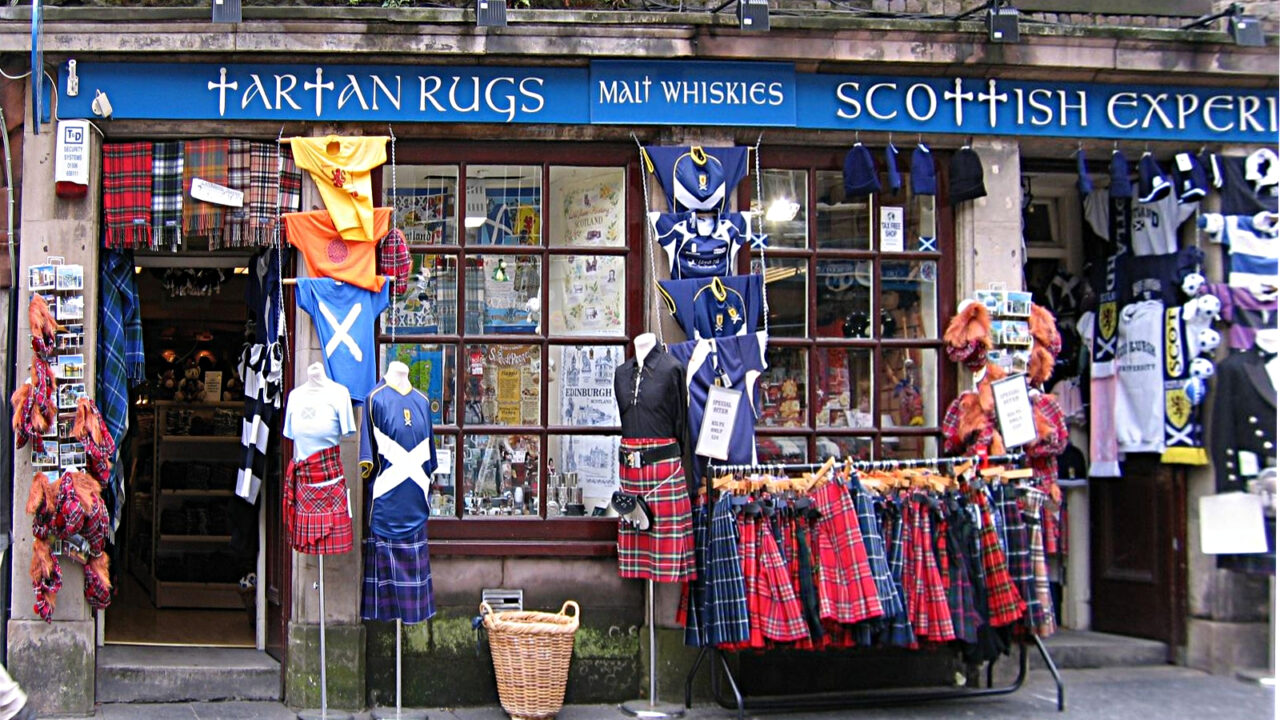
You will pass a dozen of them between the castle and Holyrood, all with tartan in the window and a sign about clan lookups. They sell the acrylic tier, sometimes competently. What they are not is kiltmakers, whatever the shopfront says, and the “clan tartan” service is a book and a search box you could use yourself.
The honest verdict: buy a scarf here if you want a scarf. Do not buy a kilt on the Royal Mile from a shop that also sells fridge magnets. The distinction between a kilt shop and a kiltmaker is the whole game, and the three or four genuine makers in this city are all easy to find.

Hire vs Buy: the Actual Maths
A hire outfit from £95 against a made-to-measure kilt at £795 sounds like an easy decision until you count events. A full outfit hire includes the kilt, jacket, waistcoat, sporran, hose, flashes, belt and shoes — everything. Buying the kilt alone gets you the kilt alone; the accessories are extra, and the bill depends on how far up the sporran ladder you go.
- One event, ever: hire. There is no argument.
- Two or three events over some years: still hire, unless your weight is stable and you enjoy owning things. A kilt fits a waist, and waists change.
- You are Scottish, or marrying into it, and expect a lifetime of weddings: buy, handsewn, once. It can be let out and taken in, and a well-made kilt is genuinely a fifty-year garment.
- You want to wear it as clothing rather than costume: buy, but consider the 21st Century Kilts route rather than tartan.
- You need it in less than five months: hire, or buy hybrid. A handsewn kilt is a 20-week commitment and no amount of paying extra reliably shortens it.
The most common expensive mistake is buying the cheap kilt as a compromise. You spend £150 on something you wear twice and then replace, when £95 of hire would have looked better on the day and £795 would have lasted your life. There is no useful middle at the bottom.
Choosing a Tartan (and Why the Clan Rules Are Softer Than You Think)
Every shop on the Royal Mile will look up your surname and produce a clan tartan. This is a real and pleasant service, and it rests on a much shakier historical foundation than the presentation suggests.
The system of one specific sett per named clan is largely a nineteenth-century invention, systematised and commercialised after George IV’s visit to Edinburgh in 1822 — an event stage-managed by Walter Scott, at which Highland dress was reinvented as national dress for the whole country. Weavers produced pattern books; families were assigned setts; the assignments stuck. Some clan associations are older and better documented than others. Many are Victorian marketing that has since become tradition, which is a real thing but not the same as an ancient right.
The honest verdict: wear what you like. Nobody in Scotland will challenge you, and the ones who might are the ones you would not want to please. If your surname has a tartan and you like it, wonderful. If you do not have one, or you find it hideous, the universal options are there for exactly this reason:
- Black Watch — dark blue, green and black. Sober, works with everything, the default for a reason.
- Flower of Scotland — a modern universal sett, open to anyone.
- Isle of Skye — soft blues and greens, popular with people who want something that is not a clan claim.
- Royal Stewart — the loudest and most photographed. Also the one most likely to be shared with three other men at the same wedding.
- District tartans — tied to a place rather than a family. If you have an Edinburgh connection rather than a Highland one, these are the honest answer.
One practical point: a tartan looks completely different as a woven kilt from how it looks as a small square in a swatch book. Ask to see a made-up kilt in the sett, or at least a length of the actual cloth held up. Fine lines that read as a pleasant check in a swatch can disappear entirely in the pleats.
Measurements, Fittings and Lead Times
A kilt is measured at three points — waist, hips and length — and the waist is not where trousers sit. A kilt sits at the natural waist, above the hip bone, which is why kilts bought to a trouser size almost always sit too low and look wrong.
Length is measured from the natural waist to the middle of the kneecap while kneeling. This is not negotiable and it is the measurement most often fudged by online sellers who take your trouser size and guess. If you are ordering remotely, a good maker will send instructions and want a second person to take the measurements.
| What you want | Realistic lead time | Book by |
|---|---|---|
| Handmade, handsewn kilt | Up to 20 weeks | Five months before the event |
| Hybrid / machine-sewn kilt | 8 to 10 weeks | Three months before |
| Off-the-peg | Same day | Whenever |
| Hire outfit | Fitting appointment, then collection | Six to eight weeks for a summer wedding |
Two practical warnings. First, summer is wedding season and hire stock runs out — a July Saturday in Edinburgh is not the day to walk in hoping. Second, if you are buying handmade and flying home, factor in that the kilt will not be ready when you leave. Every serious maker ships internationally, but check the cost before you commit, because eight yards of wool is heavy.
What Else You Need
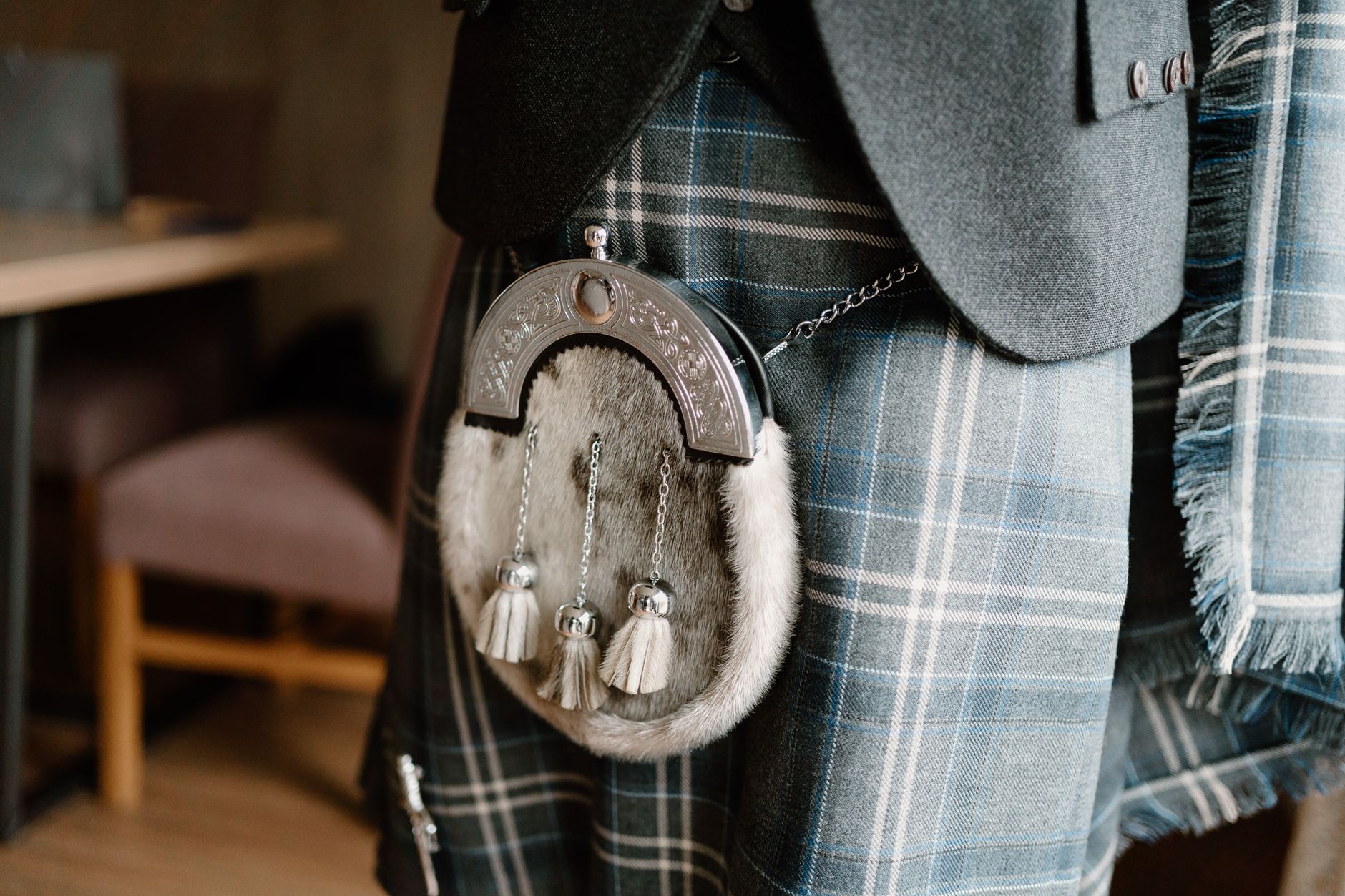
- Sporran — day sporrans in plain leather are the cheap and versatile end; dress sporrans in fur with silver cantles run into the hundreds. Comes with a chain strap.
- Jacket — an Argyll jacket is the flexible choice, worn with or without a waistcoat, day or evening. A Prince Charlie is black tie only.
- Hose and flashes — knee socks and the little ribbons that hold them up. Cream is the safe default.
- Ghillie brogues — the laced shoes. Genuinely uncomfortable for a first hour and fine after that.
- Kilt pin — goes through the top apron only. Pinning both layers together is the classic visitor error and it stops the kilt hanging.
- Sgian-dubh — the small knife in the sock. Note that you cannot take it in hand luggage, and packing one carelessly has caused a lot of people a bad afternoon at security.
If you are shipping or flying home with any of this, our guide to what to pack for Edinburgh covers the practicalities, and note that the VAT Retail Export Scheme was abolished in 2021 — there is no visitor VAT refund anywhere in Great Britain and no refund desk at Edinburgh Airport. The only route to a VAT-free purchase is having the retailer ship directly to a non-UK address, which is treated as an export. Several kiltmakers will do this; ask before you pay.
Buying a Kilt for a Woman or a Child
Both are normal and both are underserved by the guides. Women’s Highland dress runs from a full kilt cut to a woman’s measurements — which Geoffrey Tailor and others make — through to kilted skirts, hostess skirts and tartan sashes. A woman in a properly made eight-yard kilt looks entirely correct; a woman in a men’s off-the-peg kilt does not, because the hip-to-waist ratio is wrong and no amount of belting fixes it.
For children, hire or buy cheap. A child will outgrow an eight-yard kilt long before it wears out, and while kilts can be let out, the length cannot. This is the one case where the acrylic tier is straightforwardly the right answer.
Prices and lead times checked against makers’ own websites in September 2026. Where a maker does not publish prices, we have said so rather than repeating a third-party figure. Confirm current prices directly before committing.
Frequently Asked Questions
How much does a real kilt cost in Edinburgh?
A made-to-measure tartan kilt from Gordon Nicolson Kiltmakers on the Canongate is £795 as of September 2026. Machine-sewn wool kilts cut to your measurements cost less, and off-the-peg acrylic less again. Accessories — sporran, jacket, hose, shoes — come on top.
How long does it take to have a kilt made?
Up to 20 weeks for a handmade, handsewn kilt, and 8 to 10 weeks for a hybrid, according to Gordon Nicolson Kiltmakers’ published lead times. That means ordering roughly five months before a wedding. If you have less time than that, hire the outfit or buy hybrid — a handsewn kilt cannot reliably be rushed.
Where can I hire a kilt in Edinburgh and what does it cost?
Gordon Nicolson Kiltmakers hire full outfits from £95, and every hire kilt is made with a full eight yards of cloth. Kinloch Anderson also hires. Book six to eight weeks ahead for a summer Saturday — Edinburgh’s wedding season empties the hire racks.
Can I wear any tartan, or do I need a clan connection?
You can wear any tartan. The system tying one sett to one named clan is largely a nineteenth-century invention, systematised after George IV’s visit to Edinburgh in 1822. Nobody will challenge you. If you want something without a family claim attached, Black Watch, Flower of Scotland and Isle of Skye are all universal, and district tartans tie to a place rather than a family.
What does eight yards mean and why does it matter?
It is the amount of double-width tartan cloth used to make the kilt. Eight yards is the traditional figure and it gives deep pleats, real weight and a proper swing. Cheaper kilts use four or five yards, producing fewer and shallower pleats and a flatter back. Ask the maker directly how many yards are in the kilt — a straight answer is a good sign.
Is it worth buying a kilt on the Royal Mile?
It depends which shop. Gordon Nicolson at 189 Canongate and Geoffrey Tailor at 59 High Street are both genuine kiltmakers on the Royal Mile. The general souvenir shops with tartan in the window and fridge magnets by the till are retailers of off-the-peg acrylic, not makers, and their clan lookup service is a search box. Buy a scarf there, not a kilt.
Can I claim VAT back on a kilt bought in Scotland?
No. The VAT Retail Export Scheme was abolished in 2021 and there is no visitor VAT refund anywhere in Great Britain, nor a refund desk at Edinburgh Airport. The only remaining route is to have the retailer ship the kilt directly to a non-UK address, which is treated as an export. Ask the maker whether they will do this before you pay.
Should I buy or hire a kilt?
Hire for one event, or for two or three spread over years — a kilt fits a waist and waists change. Buy handsewn if you expect a lifetime of Scottish weddings, because a well-made kilt is a fifty-year garment that can be let out and taken in. The one thing to avoid is buying cheap as a compromise: £150 of acrylic worn twice is worse value than £95 of hire.
Where to Go Next
Start with our complete guide to shopping in Edinburgh for the streets these makers sit on, then Victoria Street for Harris Tweed, whisky and the Old Town independents. The Royal Mile and Old Town area guide covers the Canongate stretch where two of the makers are, and Leith and The Shore covers the district Kinloch Anderson works from. If you are shipping purchases home, what to pack for Edinburgh covers the practical side.
More Edinburgh Shopping Guides
- The best Scottish souvenirs (and what to skip)
- Cashmere, tweed and knitwear in Edinburgh
- Vintage and charity shops in Edinburgh
- Edinburgh markets: which market is on which day
Photo Credits
A Royal Mile tartan shop: Edinburgh The royal Mill by Pierre André Leclercq, CC BY-SA 4.0, via Wikimedia Commons.