St Giles’ Cathedral: The New 12 Pound Charge, the Thistle Chapel and Visitor Guide (2026)
Search for St Giles Cathedral Edinburgh and almost every result will tell you it is free to enter. As of 5 October 2026, that is no longer true. The cathedral has moved to a visitor charging model at £12 a ticket, available online and in person, with free entry retained for all residents of Scotland and all under-16s. If you have read otherwise — including in a guidebook printed this year — you have read something that is now out of date.
That change makes the rest of this guide more useful rather than less, because a £12 decision needs better information than a free one. This covers what your ticket now buys, the numbered walk through the interior that makes sense of a building altered for nine hundred years, why the Thistle Chapel is the single best thing inside it, the Sunday restriction that catches people out, and the honest verdict on whether it earns the money. All checked against the cathedral’s own pages in October 2026.
At a Glance
- Entry is now £12 from 5 October 2026, online or in person. Previously a suggested donation of £10.
- Free for all residents of Scotland and all under-16s.
- Hours: Monday–Friday 10:00–18:00, Saturday 09:00–17:00, Sunday 13:00–17:00.
- Sunday morning is closed to sightseeing. Services at 09:30 and 11:00; visiting begins at 13:00. Weekday prayers at 12:00.
- Audio tour: may be offered at the front desk, so check on the day. Guided tours run twice a day on weekdays and on Saturday mornings.
- The Thistle Chapel — Robert Lorimer, finished 1911 — is the highlight. Stalls for the 16 Knights of the Thistle plus the Sovereign’s stall and two Royal stalls, and angels playing bagpipes carved into the woodwork.
- It is not technically a cathedral. The Church of Scotland has had no bishops since 1689 and therefore no cathedrals. The name is historic.
- Foundation usually dated to 1124, attributed to David I. The crown steeple is 1460–67; the Victorian restoration ran 1872–1883.
- John Knox was minister here from 1559, preaching his final sermon on 9 November 1572.
- Allow 45–60 minutes for a proper visit; 90 with the audio tour and time in the Thistle Chapel.
The £12 Charge: What Changed and What It Means
Until this year, St Giles’ operated the model most British parish churches and cathedrals use: free to walk in, with a suggested donation of £10 asked at the door and almost universally ignored. From 5 October 2026 the cathedral has moved to a ticketed visitor model.
| Item | Detail |
|---|---|
| Visitor ticket | £12, available online and in person |
| Residents of Scotland | Free |
| Under-16s | Free |
| Previously | Suggested donation of £10 |
| Audio tour | May be offered at the front desk; check on the day |
| Guided tours | Twice daily on weekdays, plus Saturday mornings |
| Worshippers | Services continue: Sunday 09:30 and 11:00, weekday prayers 12:00 |
Alongside the charge, the cathedral is introducing hand-made interpretation panels and enhanced guided tours, and says visitors will still be “invited to enjoy the Thistle Chapel and the peacefulness of the side aisles”. So the charge buys interpretation as well as access — which matters, because the interior of St Giles’ is genuinely hard to read without help.
The honest verdict on the charge: £12 is a real price for a church interior, and it puts St Giles’ roughly halfway between a free national museum and Edinburgh Castle. It is defensible — the building costs an enormous amount to keep standing and the Church of Scotland has no cathedral endowment to draw on — but it changes the calculation for a visitor on a budget. If you have half a day and £12 to spend on one indoor thing in the Old Town, the National Museum of Scotland is free and takes three hours. If you specifically want the Thistle Chapel, nothing else in Britain is quite like it and £12 is fair.
One thing not to miss: if you live in Scotland, you go in free, and that includes students living here during term. Bring something with a Scottish address on it.
Opening Hours and the Sunday Trap
The hours are straightforward except on Sunday, which is where people lose a morning.
| Day | Visiting hours | Note |
|---|---|---|
| Monday–Friday | 10:00–18:00 | Prayers at 12:00; the building stays open around them |
| Saturday | 09:00–17:00 | Earliest opening of the week, and the quietest first hour |
| Sunday | 13:00–17:00 only | Services at 09:30 and 11:00 — no sightseeing before 13:00 |
The honest verdict on Sunday: a great many visitors walk up the Royal Mile on a Sunday morning, find the doors shut to tourists, and assume the cathedral is closed. It is not — it is being used for the thing it was built for. If you want to be inside on a Sunday morning, the answer is to attend the 09:30 or 11:00 service, which is free, open to anyone, and a genuinely better experience of the building than shuffling round it with an audio guide. You will hear the organ and the choir in a space designed for exactly that. Just go as a member of a congregation rather than as a photographer.
The best time of the week for a quiet visit is Saturday between 09:00 and 10:00 — the cathedral opens an hour earlier than on weekdays and the Royal Mile has not filled up.
A Numbered Walk Through the Interior
St Giles’ is confusing inside, and the reason is that it has been rebuilt, subdivided, stripped and restored for nine hundred years. At one point it was partitioned into four separate churches sharing one roof, with a police office and a fire station in parts of it. Nothing you see is a single coherent design. Walk it in this order and it makes sense.
1. Stop outside first, and look up at the crown
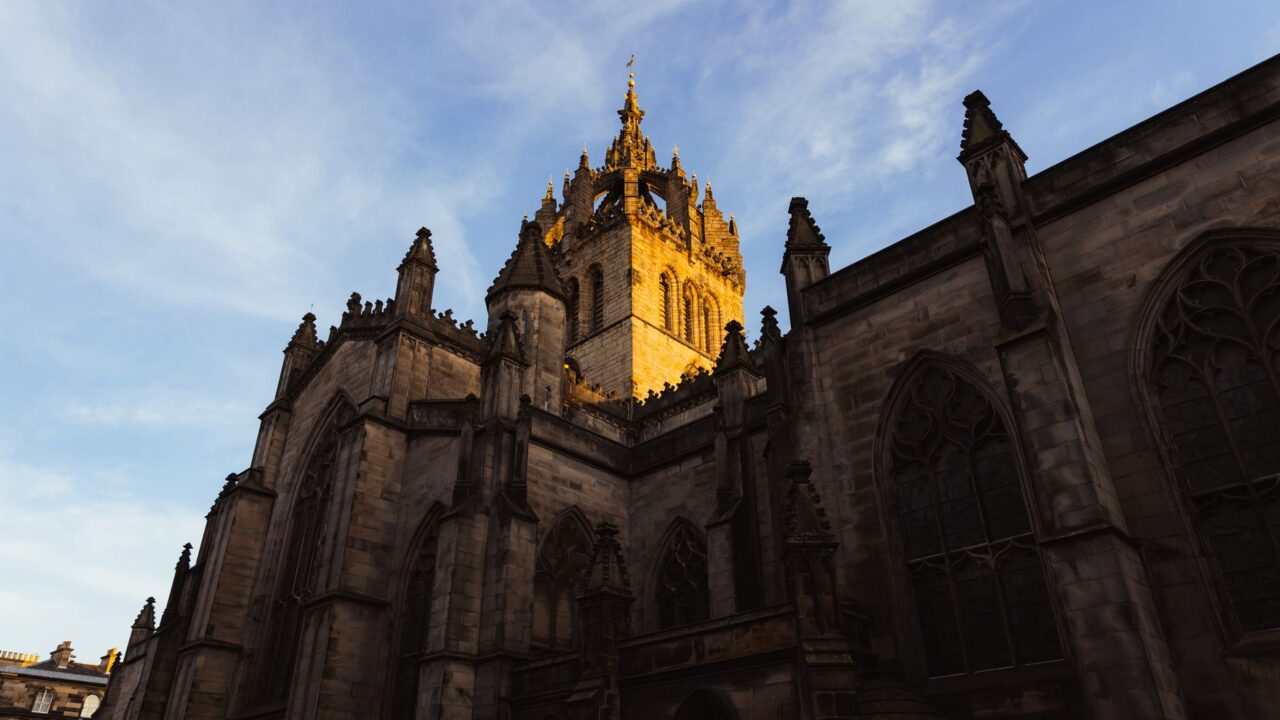
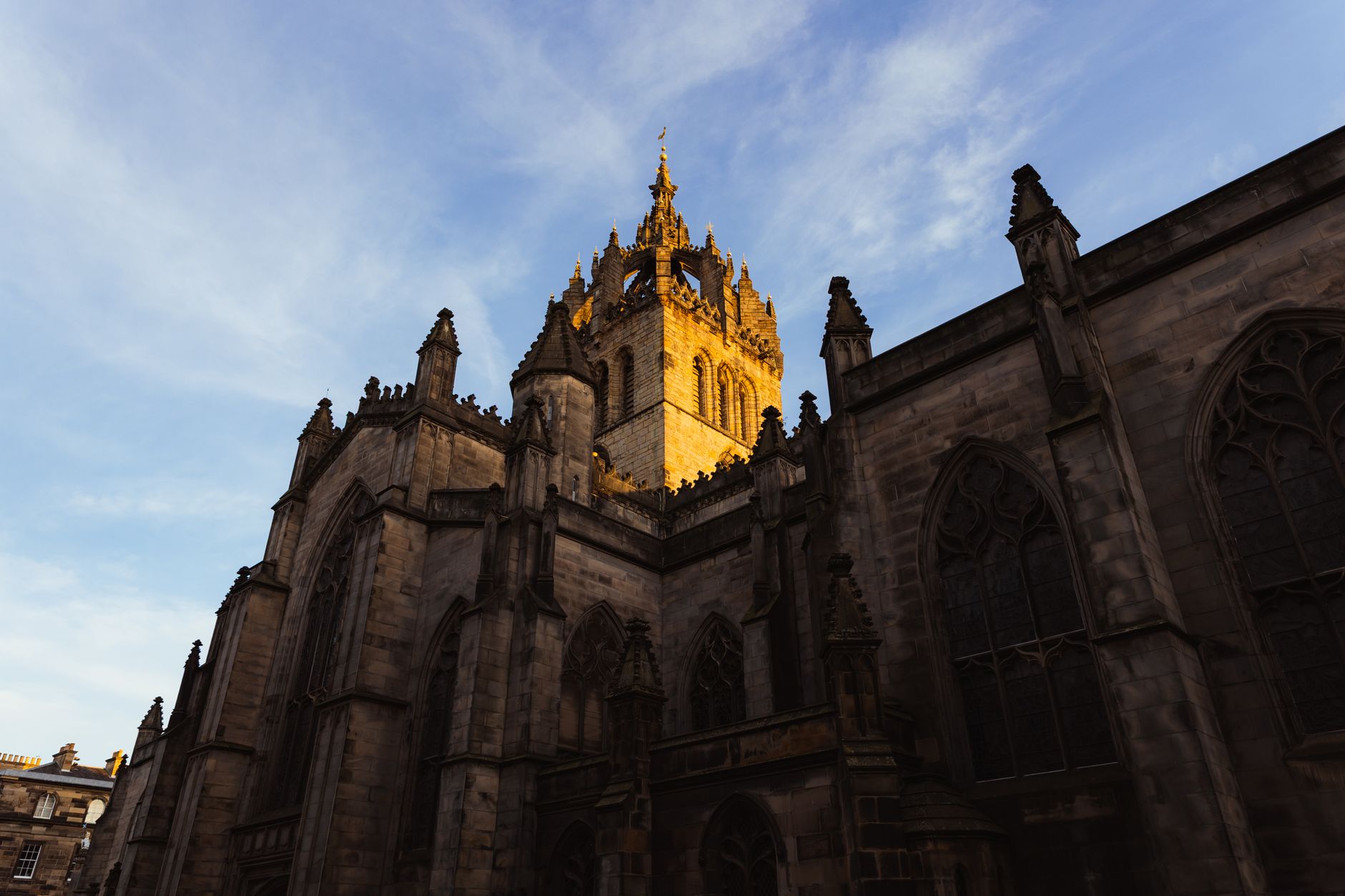
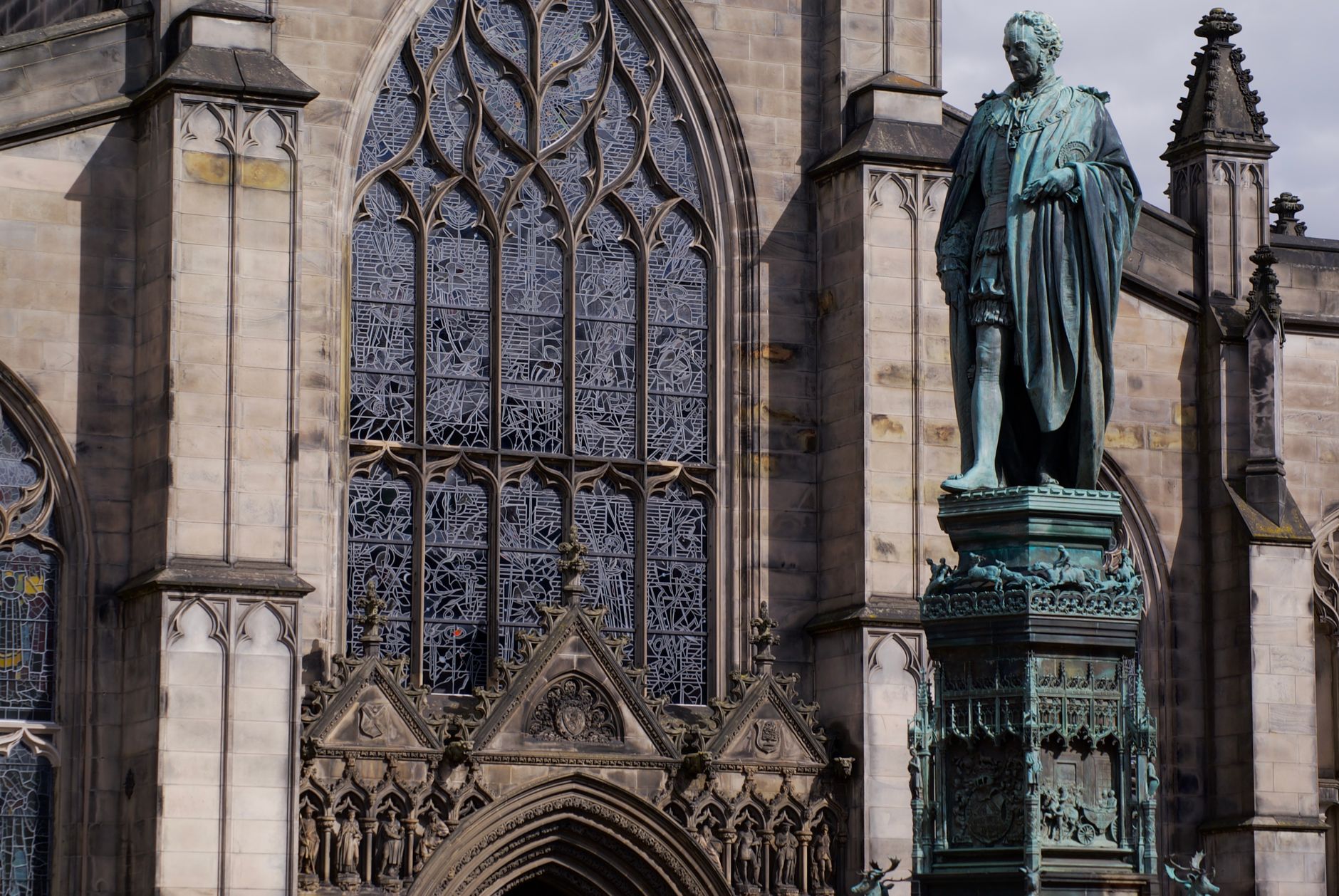
The crown steeple is the whole reason the building is famous, and you cannot see it from inside. Flying buttresses meeting in an open stone crown, dated by dendrochronological analysis to between 1460 and 1467. Only a handful of crown steeples survive in Scotland. Stand back in Parliament Square, on the south side, where you can see it clear of the Royal Mile crowds.
2. The nave and the great west window
Come in and turn to look back at the west end. The great west window is a memorial to Robert Burns, installed in 1985 and designed by the Icelandic artist Leifur Breiðfjörð, replacing a Cottier window of 1886 whose glass had failed. It is semi-abstract and deals in Burns’s themes — nature, humanity and love — with the sun in the topmost tracery blossoming, as the poem has it, like a red, red rose.
It is worth twenty seconds of context: putting a window to Burns — a man not conspicuously devout — in the High Kirk of the Church of Scotland was controversial in 1985, and the compromise reached was a design that celebrates the poetry rather than the poet.
3. John Knox
Knox first preached here on 29 June 1559 and was elected minister the following week. He preached his last sermon on 9 November 1572 and died that month. This is the building from which the Scottish Reformation was substantially driven, and the statue and memorial inside are the reason a great many visitors come.
The thing to understand standing here is that the interior Knox preached in looked nothing like this one. The Reformation stripped St Giles’ of its altars, images and colour; the Victorians spent 1872 to 1883 putting a great deal of it back, in a nineteenth-century idea of what a medieval church should look like. You are looking at a Victorian restoration of a medieval building that spent three centuries as a plain Reformed preaching hall.
4. Jenny Geddes and her stool
On 23 July 1637, the replacement of Knox’s Book of Common Order with a Scottish version of the Church of England’s Book of Common Prayer provoked rioting in this building. Tradition attributes the first act to Jenny Geddes, who is said to have thrown her stool at the minister’s head. The riot fed directly into the National Covenant and from there into the Wars of the Three Kingdoms.
There is a memorial to her inside. Whether Jenny Geddes existed as a specific individual is not settled; the riot certainly did, and the consequences ran for a century.
5. The Thistle Chapel — leave time for this
Down the Preston aisle at the east end, through a low-vaulted vestibule, four steps down. It is easy to miss and it is the best thing in the building by a distance. Detail in its own section below.
6. The side aisles and the regimental colours
Finish in the aisles, which is where the cathedral is quietest and where the memorials to Scottish regiments and the hanging colours are. The cathedral explicitly invites visitors to sit here. On a busy afternoon, five minutes in a side aisle is the only part of a Royal Mile visit that is silent.
The Thistle Chapel: the Reason to Pay
Built between 1909 and 1911 to a design by Sir Robert Lorimer, and finished in 1911. It is the chapel of the Order of the Thistle, Scotland’s great order of chivalry, founded in its current form in 1687 by King James VII, who presented it as a revival of an earlier order, and appointment to it remains one of the country’s highest honours.
Inside is a room roughly the size of a large sitting room, carved from floor to vault. It contains stalls for the sixteen Knights of the Thistle, the Sovereign’s stall, and two further Royal stalls, each under a lavishly carved canopy carrying that knight’s helm and crest. The heraldry is live — crests are replaced as knights die and are appointed.
The detail is where Lorimer’s Scottishness shows. Among the carving are angels playing bagpipes, and the windows carry heraldic and figurative stained glass. Give yourself ten minutes and look up, look at the stall backs, and find the pipers.
Access note: the chapel is entered through the low-vaulted ante-chapel at the east end of the Preston aisle, and there are four steps down at the entrance. That is a genuine barrier for wheelchair users and anyone with limited mobility, and it is the one part of the building that cannot be substituted with a view from elsewhere.
The honest verdict: if you pay £12 and spend it all in the nave, you have wasted the money. The nave is a good Victorian restoration of a much-altered medieval church, and there are three or four of those within a mile. The Thistle Chapel is a complete, coherent, extravagantly carved Arts and Crafts interior, among the finest church interiors of its era in Scotland. Go there first if you are short of time.
Why It Is Called a Cathedral When It Is Not One
A cathedral is, strictly, the church containing a bishop’s seat — the cathedra. The Church of Scotland has had no bishops since 1689, and therefore, strictly, no cathedrals. St Giles’ is properly the High Kirk of Edinburgh.
The name survives from two brief episcopal periods in the seventeenth century, and from long habit. Scotland’s actual working Anglican cathedral in Edinburgh is St Mary’s Episcopal Cathedral on Palmerston Place in the West End — a Gilbert Scott building, consecrated 30 October 1879, with the tallest spire in the Edinburgh urban area at 90 metres and the only tradition of daily choral services of any cathedral in Scotland. It is a different building with a different character, and it is a fifteen-minute walk away. Our guide to Edinburgh’s West End covers it.
None of this is pedantry for its own sake. It explains why St Giles’ has no endowment of the sort English cathedrals draw on, which is a substantial part of why it now charges £12.
Is It Worth £12?
The honest verdict, split by who you are:
- Resident of Scotland, or under 16: free. Go, obviously, and go often.
- Interested in Scottish history, the Reformation or Arts and Crafts design: yes. The Knox associations are the real thing and the Thistle Chapel is exceptional.
- On a tight budget with one day in Edinburgh: probably not. The National Museum of Scotland and the Scottish National Gallery are both free and both take longer. Look at the crown steeple from outside, which is free and is the best bit of the exterior anyway.
- Travelling with young children: under-16s are free, so the cost is one or two adult tickets. Forty-five minutes is about the limit of what a child will give you here.
- Church-crawling across Britain: yes, and take the audio tour if one is offered on the day. The building rewards knowing what was destroyed and what was put back.
- Wanting a service rather than a tour: Sunday 09:30 or 11:00, free, and a better use of the building.
For context on what else costs money on this stretch of street, see our complete Royal Mile and Old Town area guide, and free attractions in Edinburgh for the alternatives.
Practical Notes
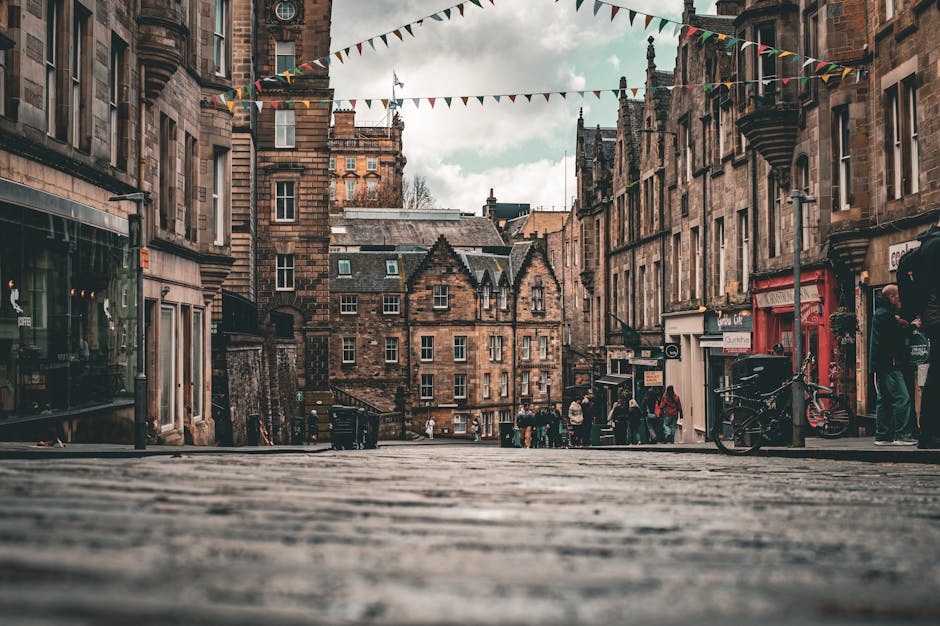
- Where: High Street, in Parliament Square, about a third of the way down the Royal Mile. Ten minutes’ walk from Waverley station, ten minutes downhill from the castle.
- Quietest hour: Saturday 09:00–10:00.
- Busiest: weekday afternoons in August, when the Royal Mile outside is at Fringe density.
- Accessibility: the main body of the church is level, but the Thistle Chapel has four steps at its entrance and no alternative route.
- Music: the choir and organ are the building’s other great asset, and you hear them properly at a Sunday service rather than on a tour.
- Combine with: the Writers’ Museum and Real Mary King’s Close, both within five minutes, and the closes and wynds running off the High Street on both sides.
Prices, hours and the visitor charging that began on 5 October 2026 checked against stgilescathedral.org.uk in October 2026. Historical dates from the cathedral’s own history pages and standard references. Confirm the current ticket arrangements on the cathedral’s site before travelling — this is a new policy and details may still be settling.
Frequently Asked Questions
Is St Giles’ Cathedral free to enter?
Not any more. From 5 October 2026 St Giles’ charges £12 for a visitor ticket, online or in person, replacing the previous suggested donation of £10. Entry remains free for all residents of Scotland and all under-16s, and services are free and open to anyone. Most guides and guidebooks have not caught up with the change.
What are St Giles’ Cathedral opening times?
Monday to Friday 10:00–18:00, Saturday 09:00–17:00, and Sunday 13:00–17:00. Sunday morning is reserved for worship, with services at 09:30 and 11:00, so there is no sightseeing before 13:00. Weekday prayers are at 12:00 and the building stays open around them.
What is the Thistle Chapel?
The chapel of the Order of the Thistle, Scotland’s great order of chivalry, founded in its current form in 1687 by King James VII. It was designed by Robert Lorimer and finished in 1911, and contains stalls for the sixteen knights plus the Sovereign’s stall and two Royal stalls, under lavishly carved canopies bearing their helms and crests. Look for the angels playing bagpipes.
How long do you need at St Giles’ Cathedral?
Forty-five minutes to an hour for a proper look, or about ninety minutes if you add an audio tour (where offered) and unhurried time in the Thistle Chapel. If you are short of time, go straight down the Preston aisle to the Thistle Chapel first — it is the part of the building that most justifies the ticket.
Can you visit St Giles’ Cathedral on a Sunday?
Yes, but only from 13:00. The morning is given over to services at 09:30 and 11:00, which are free and open to anyone who wants to attend. A great many visitors find the doors shut on a Sunday morning and assume the building is closed — it is not, it is simply being used for worship.
Why is St Giles’ called a cathedral if it is not one?
Because a cathedral houses a bishop’s seat, and the Church of Scotland has had no bishops since 1689 and therefore no cathedrals. St Giles’ is properly the High Kirk of Edinburgh; the title survives from two brief episcopal periods in the seventeenth century. Edinburgh’s working Anglican cathedral is St Mary’s on Palmerston Place in the West End.
Is St Giles’ Cathedral wheelchair accessible?
The main body of the church is level and accessible. The Thistle Chapel is not — it is entered through a low-vaulted ante-chapel at the east end of the Preston aisle, with four steps down at the entrance and no alternative route. Since the Thistle Chapel is the highlight, it is worth knowing before you buy a ticket.
What is the connection between St Giles’ and John Knox?
Knox first preached at St Giles’ on 29 June 1559 and was elected its minister the following week, preaching his final sermon on 9 November 1572 shortly before he died. It is the building from which much of the Scottish Reformation was driven. The interior he knew was far plainer than today’s — the Victorians restored much of the decoration between 1872 and 1883.
Where to Go Next
St Giles’ sits at the midpoint of our Royal Mile and Old Town area guide, which covers everything on the street in order. For the historical thread, medieval Edinburgh walks the Old Town through its history, and the closes and wynds covers the lanes running off it on both sides. If the £12 is more than you want to spend, free attractions in Edinburgh and the free museums list the alternatives, and our self-guided walking tour takes you past the crown steeple for nothing.