Harry Potter Edinburgh Locations: Complete Guide (2026)
J.K. Rowling wrote much of the early Harry Potter series in Edinburgh, and the city’s narrow closes, gothic spires, cobbled lanes and crowded graveyards are stitched into the books in ways that draw 200,000 Potter fans to Edinburgh each year. From the café where Rowling wrote her first draft on napkins to the kirkyard headstones that gave her character names, the city offers the most concentrated set of Potter pilgrimage sites in the world. This is the definitive guide to Harry Potter Edinburgh locations — every site worth visiting, the real history behind the Rowling connections, the photo spots, the walking-tour options, and the practical detail for fans of any age planning their pilgrimage.
How J.K. Rowling and Edinburgh Came Together
Joanne Rowling moved to Edinburgh in 1993 as a single mother, having left a troubled marriage in Portugal. She lived first in a small flat on South Lorne Place in Leith, then near her sister’s home in Marchmont. With her newborn daughter in a pushchair and a partial manuscript of Harry Potter in a bag, she would walk for hours, ending up in cafés where she could nurse the baby and write. The first Harry Potter book was completed in Edinburgh; the next six were also largely written here. Rowling still owns a home in the city.
Although Rowling has consistently said that no Edinburgh location directly inspired specific Potter places, the city’s atmosphere clearly soaked into the books. The narrow stepped closes that became the inspiration for Diagon Alley. The towering school spires that recall Hogwarts. The crowded centuries-old kirkyards with characterful headstones. The gloom of an Edinburgh winter morning that you can feel in any Hogwarts scene set in November. This is what Potter fans come to Edinburgh to feel.
The Cafés Where Rowling Wrote
The Elephant House
The most famous Rowling café — a small first-floor café on George IV Bridge with views across to Edinburgh Castle through the back windows. Rowling wrote here on and off through the 1990s and 2000s. The café famously declared itself “the birthplace of Harry Potter” on its sign. A serious fire in 2021 damaged the building; as of 2026, the café was being restored with reopening planned. While closed, fans gather outside for photographs of the iconic exterior. Check the latest status before visiting.
Spoon (formerly Nicolson’s Café)
The actual first café Rowling wrote in — a then-Polish café called Nicolson’s on Nicolson Street, owned by Rowling’s brother-in-law. Rowling and her baby would spend afternoons here in 1994-95 while she worked on the first book. The space is now Spoon, a relaxed bistro at 6a Nicolson Street, with a small commemorative plaque inside. Excellent breakfast and coffee. Less crowded with tourists than the Elephant House.
Other Rowling Cafés (in Order of Documentation)
- Nicolson’s Café (now Spoon) — early days of book 1.
- The Elephant House — books 1-3, much-photographed.
- Caffé Nero on Princes Street — book 4 and beyond.
- Black Medicine Coffee Co. — South Side café where she was a regular.
- The Traverse Bar Café at the Traverse Theatre — drafts of later books.
- The Balmoral Hotel — where the final words of book 7 were written.
The Balmoral Hotel: Where Deathly Hallows Was Finished
Rowling completed Harry Potter and the Deathly Hallows in Room 552 of The Balmoral Hotel in Edinburgh, on 11 January 2007. She signed and dated the upper part of a marble bust of Hermes in the room — that signature remains in place to this day. The room has since been renamed the “J.K. Rowling Suite” and is available to book (currently around £1,500 per night). Limited tours of the suite are sometimes offered for hotel guests. Fans regularly gather in the Balmoral’s Palm Court for a Potter-themed afternoon tea (£65pp).
Victoria Street: The Inspiration for Diagon Alley
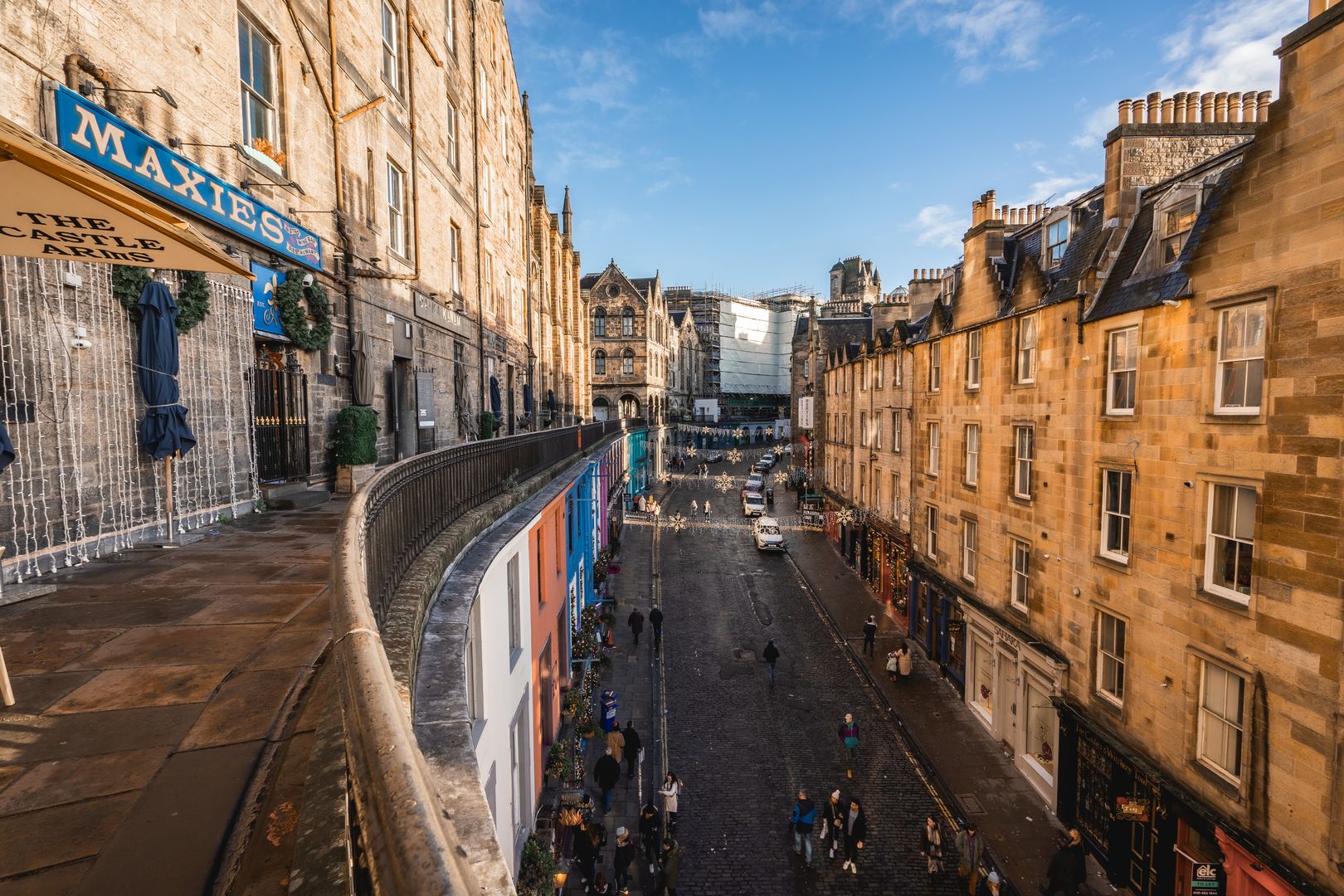
Victoria Street — the colourful curving street descending from George IV Bridge into the Grassmarket — is the most-commonly cited inspiration for Diagon Alley. While Rowling has never definitively confirmed this, the street’s character makes the comparison obvious: independent shops in brightly painted facades, a curved sweep, characterful signage, and a sense of small commerce in a tight space.
Victoria Street’s “Potter-feeling” shops include:
- The Boy Wizard (formerly Diagon House) at 40 Victoria Street — Potter merchandise, wands, robes, photo opportunities.
- Museum Context — Old curiosity shop feel.
- I.J. Mellis Cheesemonger — characterful shop signage.
- Cadenhead’s Whisky Shop — atmospheric brown-bottled interior.
- Aha Ha Ha Jokes — Edinburgh’s joke and gag shop, the closest thing to Weasleys’ Wizard Wheezes.
Photograph from the top of Victoria Street looking down (the Old Town silhouette behind), or from the Grassmarket looking back up. The street is one of Edinburgh’s most photographed and is busy with Potter tour groups year-round.
Greyfriars Kirkyard: The Source of Character Names
Of all Edinburgh’s Potter connections, Greyfriars Kirkyard is the most concrete and the most fascinating. Rowling has confirmed she walked through the kirkyard frequently and used some of its headstones for character names. Specific real graves that match Potter names:
Tom Riddle (Thomas Riddell)
The headstone of Thomas Riddell (1806-1862) stands in the south-east corner of the kirkyard, near the Flodden Wall. Rowling has confirmed she did not know about this grave when she named Voldemort’s Muggle father — but the surnames match too closely to ignore. The grave is now the most-photographed in the kirkyard, with fans leaving small tokens.
Professor Minerva McGonagall
The grave of poet William McGonagall (1825-1902) is nearby. Rowling has acknowledged borrowing the surname for Hogwarts’ Transfiguration professor.
The Original Hogwarts Headmaster?
Two prominent graves bear surnames that overlap with Potter characters: Elizabeth Moodie (close to Mad-Eye Moody’s name) and others. Some are coincidences; others Rowling has confirmed as influences.
George Heriot’s School
Visible from Greyfriars Kirkyard, the spires of George Heriot’s School are widely cited as a visual inspiration for Hogwarts. The 17th-century building has four turrets at the corners (Gryffindor, Ravenclaw, Hufflepuff, Slytherin? — many Potter tour guides make this point), a central tower, and a courtyard. Heriot’s is a working independent school and is not open to visitors, but you can photograph the building from the kirkyard.
The Iconic Castle and Spires
Edinburgh Castle
Rowling has said the Castle’s silhouette and the way it dominates the city contributed to the visual sense of Hogwarts. The Castle is not directly Hogwarts, but the dramatic perch on a volcanic plug, the gothic ramparts, and the sense of layered history are clearly part of the Potter aesthetic.
The Spires of the Old Town
St Giles’ Cathedral’s crown spire, the Tron Kirk steeple, and the various church spires across the Old Town all contribute to the city’s “Hogwarts-via-Edinburgh” character. The view from Calton Hill at twilight, with the Old Town silhouette spired against the sunset, is the most concentrated Potter-feeling photograph you can take.
Salisbury Crags and Arthur’s Seat
The dramatic backdrop to the Royal Mile, and the place where you might imagine a hippogriff would roost. Sometimes cited by tour guides as the visual influence for Hogwarts’ grounds.
Other Edinburgh Potter Pilgrimage Spots
The Spoon Apartment Where Rowling Lived
South Lorne Place in Leith (number 5) was Rowling’s first Edinburgh address. The flat is private and is not visitable, but the street can be walked. It is on the Lothian 22 bus route.
The Royal Mile
Walking the Royal Mile from west (Castle) to east (Holyrood) is the closest you’ll get to the feel of a Diagon Alley shopping run. The Hub, the closes, the cobbles, and the closes-and-wynds branching off — all evocative.
The Old Town Closes
Particularly Anchor Close, Brodie’s Close, Advocate’s Close, Tweeddale Court, and Riddle’s Court (yes — really called that). Each is atmospheric in a way that suggests Diagon Alley side-streets or Knockturn Alley.
Hogwarts in the Snow (Mid-Winter Edinburgh)
If you visit Edinburgh between mid-December and February, snow occasionally dusts the Castle, George Heriot’s School, the spires, and the closes — exactly the Potter aesthetic. Best photographs after an overnight snowfall, before the wind clears it.
Potter-Themed Shops in Edinburgh
The Boy Wizard (Diagon House)
40 Victoria Street. The biggest Potter shop in Edinburgh. Wands, robes, scarves, mugs, and everything else. Photographic opportunities outside. Often a queue in summer.
The Wizardry Shoppe
Royal Mile. Slightly smaller, with a more historical wand collection.
Aha Ha Ha Jokes
Victoria Street. Joke and gag shop with Potter-adjacent humour.
Owl & the Pussycat
An independent bookshop in the West End with strong Harry Potter sections and frequent themed displays.
Toppings Bookshop on Edinburgh’s Cathedral Square
Major independent bookshop with a curated Harry Potter section.
Potter Walking Tours in Edinburgh
Several operators run dedicated Potter walking tours of Edinburgh. Recommended:
The Potter Trail
The longest-running free Potter walking tour. Daily at 13:00 from Greyfriars Bobby statue. Free; tips appreciated. Highly entertaining guide stories. 90 minutes.
Mercat Tours’ Harry Potter Tour
Professional ticketed tour, deeper history. £15-20. Daily.
City of the Dead Tour’s Potter Connection
Their Greyfriars-focused tour covers the headstones in detail.
Witchery Tours
Costumed Potter-adjacent ghost tours.
Audio-Guided Self-Tour Apps
Several apps (VoiceMap, PocketGuide) offer self-paced Potter trails.
The Self-Guided Edinburgh Potter Day
For visitors planning their own pilgrimage, this is a manageable single-day route:
09:00 — The Balmoral Hotel
Start at the Balmoral on Princes Street. Photograph the entrance. (If staying or having afternoon tea, ask about Room 552.)
09:30 — Walk via Cockburn Street to the Royal Mile
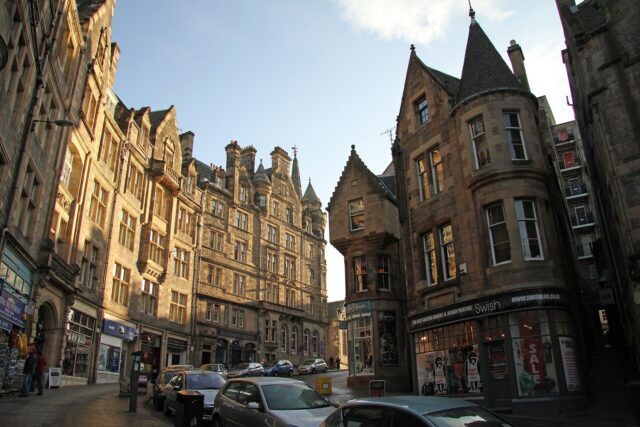
The cobbled stepped close that descends from the Royal Mile feels distinctly Potter.
10:00 — Edinburgh Castle (Optional)
For the architecture and views. Pre-book a 10:00 slot. 2 hours.
12:30 — Lunch at The Elephant House (if open) or Spoon
The cafés where Rowling wrote.
14:00 — Greyfriars Kirkyard
The Tom Riddle headstone, William McGonagall grave, view across to George Heriot’s School. Allow 60 minutes.
15:30 — Victoria Street
Walk down from George IV Bridge. The Boy Wizard shop. Photographic stops.
16:30 — Coffee or Drinks at The Bow Bar
Atmospheric Old Town pub.
17:30 — Calton Hill Sunset
The Old Town silhouette in twilight.
19:30 — Dinner at The Witchery
Gothic theatre, candlelit, the most Potter-feeling restaurant.
Best Photo Spots
- The Elephant House exterior (from George IV Bridge).
- The Balmoral Hotel entrance.
- Victoria Street from the top, looking down.
- The Tom Riddle headstone in Greyfriars Kirkyard.
- George Heriot’s School spires from Greyfriars.
- St Giles’ Cathedral crown spire from the Royal Mile.
- Calton Hill at twilight with the Old Town silhouette.
- Cockburn Street stepped close.
- The Castle Esplanade at dusk.
- Edinburgh Old Town in fresh snow.
Edinburgh’s Other Literary Influences on Potter
Rowling has cited several non-Edinburgh influences on Potter (Tolkien, C.S. Lewis, Jane Austen, Roald Dahl) but Edinburgh’s literary tradition almost certainly soaked in too:
- Robert Louis Stevenson — born in Edinburgh, wrote ‘Strange Case of Dr Jekyll and Mr Hyde’. The Old Town’s split character clearly echoed into the Death Eater / Order of the Phoenix split.
- Sir Walter Scott — Edinburgh’s literary giant. The Scott Monument on Princes Street is one of the city’s icons.
- Robert Burns — Scotland’s national poet. Echoes in the boyish, charming masculinity of Sirius Black.
- Ian Rankin — contemporary Edinburgh crime writer.
- Alexander McCall Smith — author of the 44 Scotland Street series.
See our Edinburgh literary history deep-dive for more.
Edinburgh Potter Itinerary by Length
Half Day (3-4 hours)
Elephant House exterior → George IV Bridge → Greyfriars Kirkyard → Victoria Street → optional Calton Hill sunset.
Full Day (8-10 hours)
Balmoral → Cockburn Street → Castle → Spoon café lunch → Greyfriars Kirkyard → George Heriot’s School view → Victoria Street → Cocktails → Witchery dinner.
Multi-Day Pilgrimage (3 days)
Day 1: All Edinburgh Potter sites plus a guided Potter Trail tour. Day 2: Hogwarts inspirations (Edinburgh Castle, George Heriot’s), the Royal Mile closes deep dive, dinner at The Witchery. Day 3: Day trip to Glenfinnan Viaduct (the Hogwarts Express bridge from the films) — 3.5 hour drive each way, or via Jacobite Steam Train.
The Wider Potter Pilgrimage Beyond Edinburgh
If you have time to extend the trip into Scotland:
Glenfinnan Viaduct
The dramatic curved bridge crossed by the Hogwarts Express in the films. Located near Fort William in the Western Highlands. Best visited on the Jacobite Steam Train, which runs over the viaduct in both directions. Half-day excursion from Fort William; full-day excursion from Edinburgh (long train + bus combination, often easier as part of a multi-day Highland trip).
Loch Eilt
The loch with the small island visible from the Glenfinnan area — used for the Dumbledore tomb scene in the films.
Glencoe
Featured in Prisoner of Azkaban as Hagrid’s hut location. Reachable on most Highland day tours from Edinburgh.
St Andrews
The university town where Prince William and Catherine, Duchess of Cambridge, met. Not directly Potter but adjacent to the British royal-meets-magical aesthetic.
Edinburgh Potter Tour Tips
- The Tom Riddle headstone is at the south-east corner of Greyfriars Kirkyard — ask a guide if you need help locating it.
- Victoria Street is most photogenic in soft afternoon light or after rain.
- The Elephant House status changes — check before visiting.
- The Balmoral Room 552 requires booking; you cannot just visit.
- George Heriot’s School is a working school — photograph from outside only.
- Books in The Boy Wizard shop are unofficial; for licensed Potter merchandise, look at Warner Bros Studio Tour in London (or international shops).
- The Potter Trail walking tour is free but the guide depends heavily on tips; £5-10 is appropriate.
When to Visit for the Best Potter Experience
- Winter (December-February): the most Potter-feeling season. Snow on the Castle, gothic dark afternoons, dramatic silhouettes. The downside is short daylight.
- Autumn (September-November): excellent autumn colour at Greyfriars Kirkyard. Atmospheric mist on the Royal Mile.
- Spring (March-May): longer days, mild weather, fewer crowds.
- Summer (June-August): longest daylight but most crowded. Tour-bus Potter groups can be intense.
Potter Tour Tickets and Pricing
- The Potter Trail (Sandemans-style free tour): tip-based, £5-15 recommended.
- Mercat Tours Potter Tour: £15-22.
- City of the Dead Tour: £15-22.
- Witchery Tours: £15-22.
- Edinburgh Castle: £23.50 online, £26 at the gate (separate purchase).
- Greyfriars Kirkyard: free to enter.
- The Boy Wizard / Potter shops: free to enter; merchandise £5-£200+.
- Balmoral afternoon tea: £65-£85.
- Room 552 at Balmoral: £1,500+ per night.
Frequently Asked Questions
Where did J.K. Rowling write Harry Potter in Edinburgh?
The Elephant House café on George IV Bridge is most famously associated; Nicolson’s Café (now Spoon) on Nicolson Street was her actual first café. She finished the final book at the Balmoral Hotel.
Is The Elephant House still open?
A 2021 fire damaged the building. As of 2026 it was undergoing restoration with reopening planned. Check the latest status before visiting.
What inspired Diagon Alley?
Victoria Street in Edinburgh is the most-commonly cited inspiration — the curving descent, colourful independent shops, and characterful signage.
Where is the Tom Riddle grave in Edinburgh?
Thomas Riddell’s headstone in the south-east corner of Greyfriars Kirkyard. Free to visit any time the kirkyard is open.
What is the Hogwarts inspiration?
George Heriot’s School (visible from Greyfriars Kirkyard) is widely cited as a visual inspiration for Hogwarts, with its four corner turrets and central tower.
Can I visit Room 552 at the Balmoral?
The room (now called the J.K. Rowling Suite) is bookable for around £1,500 per night. You cannot tour it casually, but the Balmoral’s Palm Court is open for afternoon tea where you can ask about the Potter connection.
Is the Potter Trail walking tour worth it?
Yes — the free daily walking tour from Greyfriars Bobby is one of the best ways to see the sites with informed commentary.
How long does an Edinburgh Potter day take?
A full Potter day is 8-10 hours. A focused half-day covers the highlights in 3-4 hours.
Are there Potter shops in Edinburgh?
Yes — The Boy Wizard on Victoria Street is the largest. Several others scatter the Royal Mile and Victoria Street.
Was Harry Potter actually set in Edinburgh?
No — the books are set in a fictional version of England and Scotland. But Edinburgh’s atmosphere, Rowling’s writing locations, and several name inspirations make the city the most concentrated Potter pilgrimage destination.
Final Word: The Most Concentrated Potter Pilgrimage
For Harry Potter fans, Edinburgh delivers what no other location can — the city where J.K. Rowling wrote, the headstones that named characters, the spires that suggested Hogwarts, and the closes that hint at Diagon Alley. Walk it slowly. Sit in a café where she sat. Stand at a graveside that gave a character their name. Photograph Victoria Street at golden hour. By the end of the day, you will have a deeper sense of how the books emerged from the city than any film tour could provide.
For wider literary planning, see our J.K. Rowling’s Edinburgh deep-dive, our Edinburgh literary history guide, and our Edinburgh bookshops and literary cafés piece. For other film-and-TV locations, see our Edinburgh film locations guide.