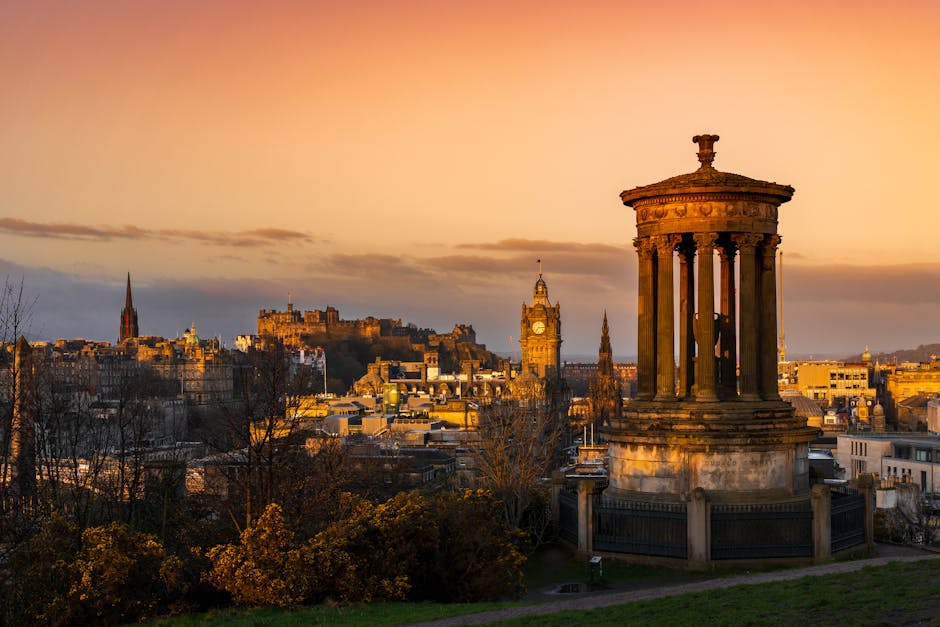
Calton Hill is the easiest of Edinburgh’s seven hills to climb, the most photographed viewpoint in the city, and the closest thing the Scottish capital has to a public art gallery in the open air. A 15-minute walk from Princes Street and only 103 metres tall, Calton Hill rewards a near-effortless climb with the canonical Edinburgh skyline image — Edinburgh Castle to the west, Arthur’s Seat to the south, the New Town fanning below, the Firth of Forth glinting north — and a strange, slightly otherworldly cluster of neoclassical monuments at the summit that has earned the area the nickname “Edinburgh’s Acropolis.”
This guide is a complete visitor manual for Calton Hill: every monument, every walking route up the hill, the best time to visit for sunset and sunrise, free vs paid attractions, the Beltane Fire Festival, accessibility, what to bring, and how to plan a Calton Hill visit alongside the rest of Edinburgh. Information is checked against Historic Environment Scotland, Edinburgh World Heritage, and the City of Edinburgh Council’s open-spaces team.
What Is Calton Hill?
Calton Hill is a small volcanic plug at the eastern end of Edinburgh’s New Town. The hill rises to 103 metres above sea level and forms part of the city’s UNESCO World Heritage Site. From its summit, you have an unobstructed 360° view of central Edinburgh — and a startling open-air complex of neoclassical buildings, columns, and observatories that together earned 19th-century Edinburgh the nickname “the Athens of the North.”
The hill is permanently open, free to access, and is one of Edinburgh’s most beloved public spaces. The combination of effortless walk, dramatic monuments, and the city’s best free panorama makes it the single most reliable Edinburgh recommendation for visitors of any age.
For broader context on Edinburgh’s viewpoints, see our companion guide on best views in Edinburgh. For Edinburgh as a whole, our pillar guide on Edinburgh Castle sits below the hill, and our piece on things to do in Edinburgh includes the hill among its top recommendations.
How to Get to Calton Hill
Calton Hill has multiple access routes. The easiest is via Regent Road, immediately east of Princes Street. From the Balmoral Hotel, walk east along Princes Street’s continuation (Waterloo Place), then up the stone steps that climb behind the Royal High School. The full walk-and-climb takes 10-15 minutes from central Princes Street.
Stone steps from Regent Road: The most direct route. Roughly 100 stone steps. Steep but short.
Hume Walk: A wide tarmacked path that climbs gradually to the summit, opened in 1775 and named for the philosopher David Hume. Has been called the first public footpath in Britain. The gentler option for buggies, those with mobility issues, or anyone wanting the slower route.
Vehicle access: A small access road allows limited driving up to a top car park (capacity around 20 spaces). Parking fills quickly in summer evenings; it’s much easier to walk.
Public transport: The closest tram stop is St Andrew Square (10 minutes’ walk). Lothian Buses 1, 4, 5, 19, 22, 25, 26, 34, and others stop on or near Princes Street and Waterloo Place. The closest railway station is Edinburgh Waverley (12 minutes’ walk).
The Monuments of Calton Hill
The summit of Calton Hill is a permanent open-air museum of neoclassical and early-19th-century architecture. The major monuments:
1. The National Monument of Scotland
The largest and most photographed structure on Calton Hill — and the most famous unfinished building in Britain. The National Monument was designed jointly in 1822 by William Henry Playfair and Charles Robert Cockerell to commemorate Scottish soldiers and sailors lost in the Napoleonic Wars. It was modelled on the Parthenon in Athens and intended to feature 12 facades, 24 perimeter columns, and an underground burial vault for Scottish heroes.
Construction began in 1826 with great fanfare. By 1829, with only 12 columns and the architrave completed, funds ran out. The 100,000 pounds needed to complete the project never appeared. The monument has stood essentially as it stopped — a partial Parthenon — for nearly 200 years.
The locals’ nickname for it is “Edinburgh’s Disgrace,” but most visitors find the partial structure more interesting than the completed monument would have been. The National Monument is the most photographed feature on the hill — particularly framed against the Old Town and Castle for sunset compositions. It is free to walk between and inside the columns at any time.
2. The Nelson Monument
The Nelson Monument is a 32-metre commemorative tower honouring Vice-Admiral Horatio Nelson, completed in 1816 to designs by Robert Burn. Shaped roughly like an upturned telescope (Nelson’s preferred instrument), the tower has a 143-step internal spiral staircase and a public viewing gallery at the top, plus a “time ball” on its roof that drops at exactly 1pm each day in synchronisation with the One O’Clock Gun fired from Edinburgh Castle.
Climbing the Nelson Monument adds approximately 30 metres to your Calton Hill view, with a uniquely high perspective directly over the city. There is a small admission fee. Last entry is approximately 4pm in summer, 3pm in winter. The narrow spiral staircase is challenging for visitors with claustrophobia or limited mobility.
3. The Dugald Stewart Monument
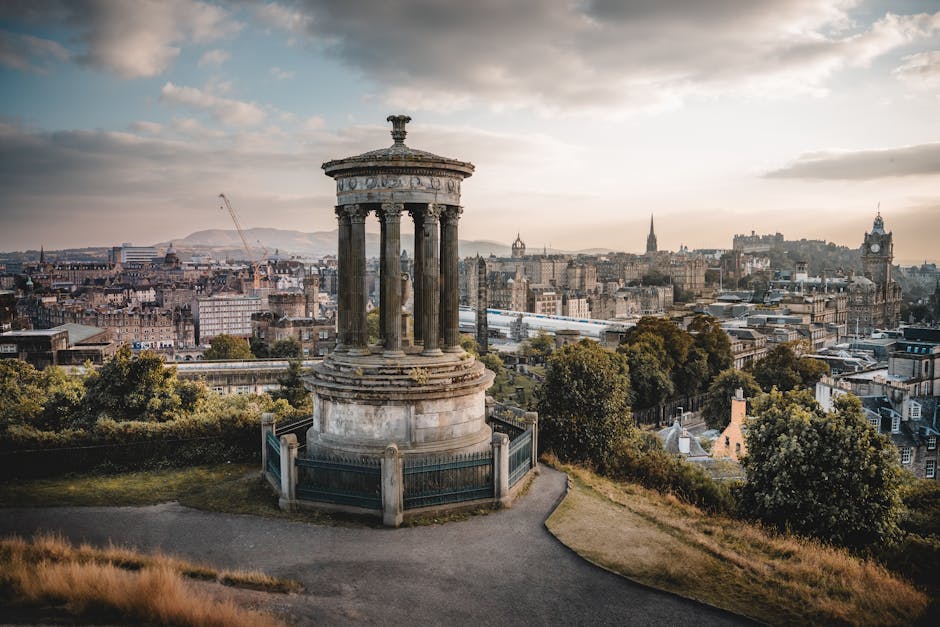
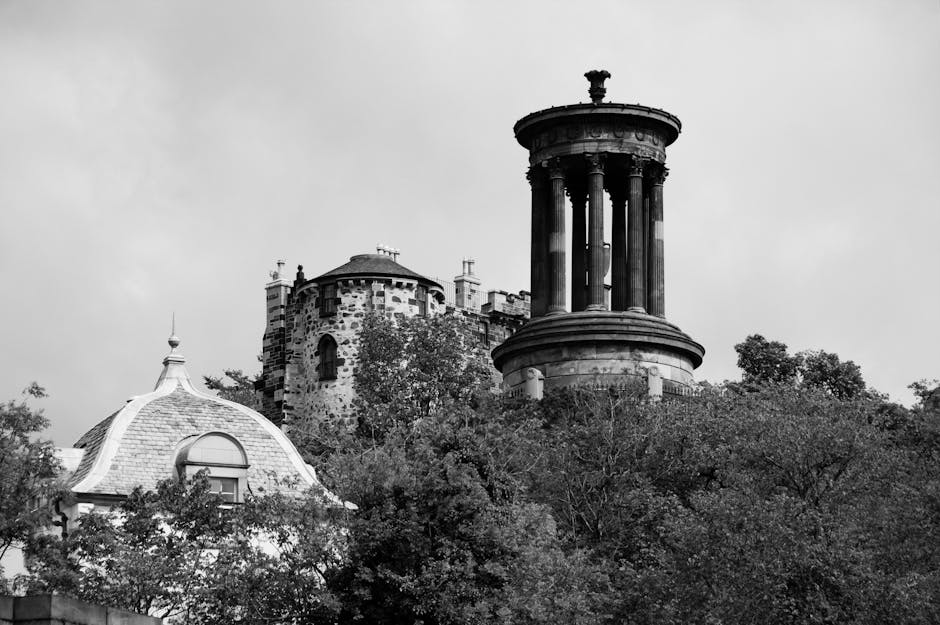
The small circular Greek-temple-like monument near the southwestern edge of Calton Hill is the Dugald Stewart Monument, designed by William Henry Playfair in 1831 to honour the Scottish philosopher Dugald Stewart (1753-1828). Modelled on the Choragic Monument of Lysicrates in Athens, it is the single most photographed subject in Edinburgh — generally framed against the city skyline at sunset, with the castle visible behind.
The Dugald Stewart Monument is open to walk inside (it’s hollow, with stone columns supporting a small dome) and is the spot where most photographers set up for the canonical “Calton Hill sunset” image.
4. The Old Royal Observatory & City Observatory
Calton Hill’s astronomical buildings include the late-18th-century Old Royal Observatory and the early-19th-century City Observatory, both designed by Playfair. The City Observatory was reopened in 2018 as the Collective contemporary art gallery, with rotating exhibitions and a notable rooftop café (the Lookout) cantilevered out over the hill with a panoramic dining-room view of the Old Town. The Old Royal Observatory functions as part of the same arts complex.
The Collective is free to visit during opening hours. The Lookout requires a restaurant reservation.
5. The Burns Monument
A short walk down Calton Hill’s southern flank, the Burns Monument is a small Greek-revival temple commemorating Scotland’s national poet Robert Burns, completed in 1830. Modelled on the Choragic Monument of Lysicrates (the same Athenian original that inspired the Dugald Stewart Monument), it once held a marble statue of Burns that has since been moved to the Scottish National Portrait Gallery.
6. The Old Calton Burial Ground
At the foot of the hill is the Old Calton Burial Ground, a small graveyard containing the tombs of philosopher David Hume, publisher William Blackwood, and several Scottish-American Civil War veterans. The Lincoln Statue here, a bronze of Abraham Lincoln, was erected in 1893 as the first statue of an American president outside the United States.
7. The Robert Burns Monument and Lord Nelson’s Time Ball
Smaller features on the summit and slopes include carved military memorial plaques, a captured Russian cannon from the Crimean War, and the Time Ball mechanism on the Nelson Monument’s roof.
The Best Time to Visit Calton Hill
Sunset (the canonical visit)
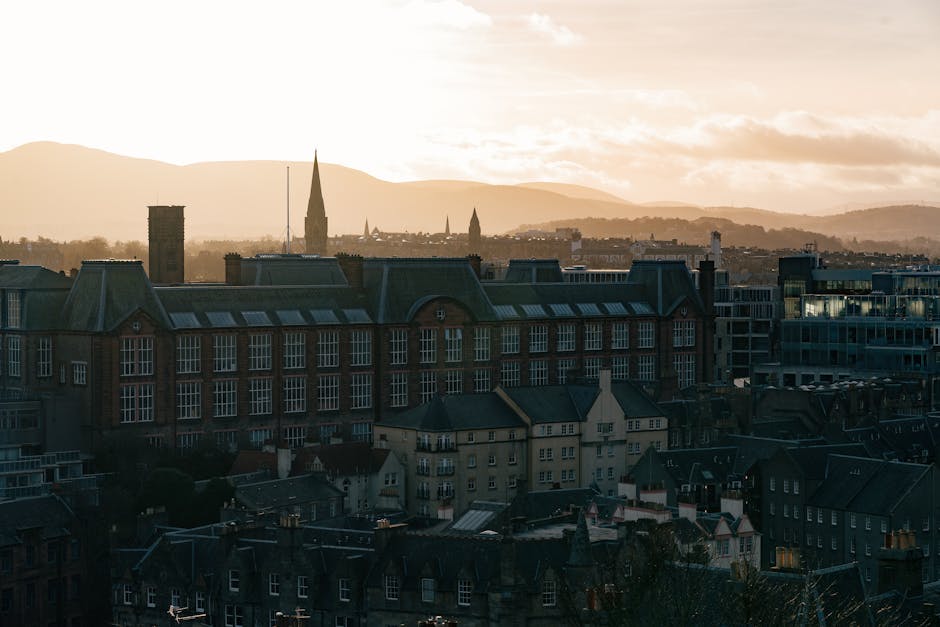
Sunset is when Calton Hill earns its reputation. The sandstone of the Old Town glows amber. The silhouette of the National Monument stands etched against the sky. Most evenings someone is playing bagpipes from one of the columns. The whole city dims as the lights flick on.
Sunset times in Edinburgh:
December 21: 3:39pm.
March 21: 6:18pm.
June 21: 10:03pm.
September 21: 7:08pm.
Arrive 30-60 minutes before sunset to claim a good spot. Expect serious crowds in summer (July-August) and around the Festival.
Sunrise (the secret time)
Edinburgh’s sunrise on Calton Hill is genuinely one of the city’s best-kept secrets. Even in summer, when sunset draws hundreds, sunrise often delivers the hill almost empty. The light is different — cooler, more eastern — and the panorama looks across to a brightening sky behind the New Town. Sunrise times: 8:43am in late December, 4:26am in late June.
Blue Hour & Night
The 30 minutes after sunset, when the floodlit castle ignites against a deep blue sky, is the most dramatic photographic time on the hill. The hill is open day and night, and the slow night-photography crowd often outnumbers the sunset photographers by 9pm.
Winter Atmosphere

Winter on Calton Hill is uniquely Edinburgh. The hill becomes near-empty between November and February. Snow occasionally dusts the summit. The sunset window arrives as early as 3:30pm in mid-December, making the hill an after-work destination for locals.
Special Events
Beltane Fire Festival (30 April): The most extraordinary event in Calton Hill’s calendar. A modern revival of the ancient Gaelic May Day fire festival, Beltane is a ticketed but largely non-commercial spectacle of painted performers, drumming, and fire dancing on the hill summit. Several thousand spectators ring the summit each year. Tickets typically £10-£15. Book ahead.
Hogmanay (31 December): The hill is one of the best vantage points for the central Edinburgh fireworks display. Police restrict access on the evening, and tickets are required for the official Hogmanay Concert in the Gardens — but secondary viewing from elsewhere on the hill is sometimes possible.
For broader seasonal planning across Edinburgh, see our pillar on the best time to visit Edinburgh.
The Lookout: Edinburgh’s Most Dramatic Restaurant
The Lookout, run by Gardener’s Cottage, sits in a glass-walled cantilevered building on Calton Hill’s southwestern edge. The dining room hangs out over the hill, with a glass wall providing a panoramic Edinburgh view across to the castle. The food is modern Scottish; the menu changes seasonally.
Reservations are essential, particularly for sunset slots in summer (often booked two months ahead). For a special occasion meal with the city’s most dramatic dining-room view, the Lookout is hard to beat. Open for breakfast, lunch, and dinner.
Photography on Calton Hill
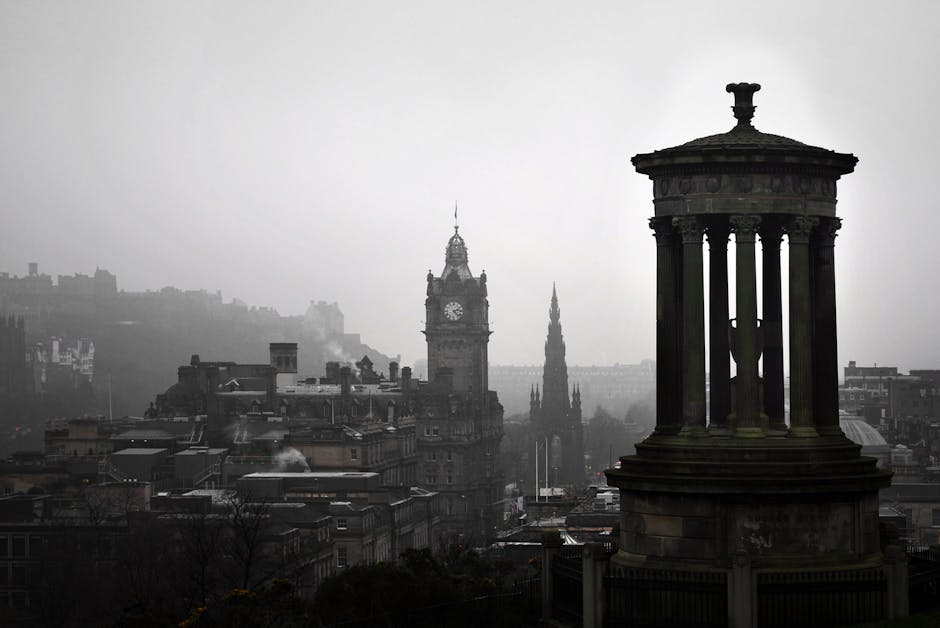
Calton Hill is the single most-photographed viewpoint in Edinburgh. The classic compositions:
Dugald Stewart Monument framed against the castle at sunset. The single most reproduced Edinburgh photograph.
Looking through the National Monument columns. Frame the Old Town through the gap between two Doric columns.
Wide skyline including Arthur’s Seat. South-facing composition that captures both the Old Town and the volcano.
Nelson Monument tower. Iconic vertical composition.
Bagpiper at sunset. Catch the local bagpiper who often plays on the hill at golden hour.
Tripods are permitted everywhere on the hill. Drones are restricted under Edinburgh’s central drone rules; check the Civil Aviation Authority’s flight maps before flying. For the full photography location guide, see our companion piece on Edinburgh Castle photography.
Walking from Calton Hill: What to See Next
Calton Hill is on the eastern edge of the city centre, perfectly placed for combining with several other major attractions:
Royal Mile (15 minutes’ walk south): Walk down North Bridge or Calton Road to reach the Royal Mile. Combine with a Edinburgh Castle visit at the top, or Holyroodhouse at the foot.
Holyrood Park & Arthur’s Seat (20 minutes’ walk south-east): The bigger volcanic neighbour. A natural pairing — sunset on Calton Hill, sunrise from Arthur’s Seat the next day.
Princes Street Gardens (5 minutes’ walk west): Combine your Calton Hill visit with the gardens for a complete central walk.
St Andrew Square (10 minutes’ walk west): Coffee at one of the New Town’s elegant cafés.
Leith (40 minutes’ walk north or 15 minutes by bus): Dinner at a Leith restaurant after sunset on Calton Hill.
Calton Hill in History
Calton Hill’s significance reaches back to prehistory. The hill has been recognised as a meeting place since at least the medieval period; one of the earliest mentions is in 12th-century records of the burial of plague victims. By the 16th century, the slopes were used for archery practice and gallows execution; the place name “Calton” may derive from the Gaelic “calltuinn” (hazel) or from the Old English meaning “hilly area.”
The 18th century saw the hill systematically developed as a public space. Hume Walk, opened in 1775 and named for philosopher David Hume, has been called the first public footpath in Britain. The Old Calton Burial Ground was established in 1718. The Old Royal Observatory was built in 1776.
The 19th-century building boom under William Henry Playfair and his contemporaries gave the hill its current neoclassical character. The combination of the National Monument, Nelson Monument, Dugald Stewart Monument, City Observatory, and surrounding buildings gave Edinburgh a serious claim to being “the Athens of the North.”
The hill became part of Edinburgh’s UNESCO World Heritage Site in 1995, recognising both its individual buildings and its contribution to the broader Old Town and New Town landscape.
Practical Tips for Visiting Calton Hill
Bring layers. Calton Hill is exposed and windy. Even on warm summer days, the summit is several degrees cooler than the city below.
Wear good shoes. The stone steps are uneven; the grass is often damp. Walking shoes are better than fashion footwear.
No buggies on the steps route. Use Hume Walk for buggy access. The summit lawns are buggy-friendly.
Toilets: No public toilets on the hill itself. The closest are at Waverley Station (5 minutes’ walk) or in the Princes Mall.
Picnics: Permitted and encouraged. Many locals bring a flask, sandwiches, or wine for sunset.
No alcohol licensing restrictions on the hill, but be sensible. Glass bottles are discouraged.
Pets: Dogs allowed on leads.
Drones: Generally restricted in central Edinburgh. Check Civil Aviation Authority maps.
Wheelchair access: Hume Walk is largely flat to gentle gradient; the summit lawns are accessible. The Nelson Monument’s spiral staircase is not accessible.
Sample Calton Hill Itineraries
The 30-Minute Quick Visit
Climb the steps from Waterloo Place. Walk between the National Monument columns. Photograph the Dugald Stewart Monument. Descend via Hume Walk. Total: 30 minutes.
The 1-Hour Sunset Visit
Arrive 45 minutes before sunset. Walk the full summit perimeter, photographing the city from each angle. Stop at the Dugald Stewart Monument at golden hour. Stay 30 minutes after sunset for blue hour. Descend via Hume Walk to dinner in the city.
The Half-Day Calton Hill Visit
Coffee at the Lookout café (book in advance). Walk the hill, including the Nelson Monument climb (admission fee). The Collective gallery exhibition. Lunch at the Lookout. Burns Monument and Old Calton Burial Ground on the way down. Total: 4-5 hours.
The Two-Hill Day
Sunrise on Calton Hill (around 5am in summer, 8:30am in winter). Coffee. Royal Mile walk. Lunch in the Old Town. Climb Arthur’s Seat in the afternoon. Sunset on Calton Hill again. Bagpipes optional but likely.
Frequently Asked Questions
Is Calton Hill free to visit?
Yes. Calton Hill is a public space, open day and night, free to visit. The Nelson Monument’s interior climb has a small admission fee; the Lookout restaurant requires reservations and standard meal pricing. The National Monument, Dugald Stewart Monument, and the summit lawns are completely free.
How long does it take to walk up Calton Hill?
The walk up via the Regent Road steps takes 5-10 minutes. Hume Walk’s gentler tarmacked path takes 10-15 minutes. From central Princes Street, allow 15-20 minutes including the approach.
What is the best time to visit Calton Hill?
Sunset is when Calton Hill is most magical. Arrive 30-60 minutes before sunset for the best experience. Sunrise is the most photogenic time with the fewest crowds. Winter weekday afternoons deliver near-empty conditions.
Can you climb the Nelson Monument?
Yes. The 143-step spiral staircase climbs to a public viewing gallery near the top. Small admission fee. Last entry approximately 4pm in summer, 3pm in winter. Not suitable for visitors with claustrophobia or limited mobility.
What is the National Monument on Calton Hill?
The National Monument is an unfinished 1820s reconstruction of the Parthenon, intended to commemorate Scottish soldiers and sailors lost in the Napoleonic Wars. Funds ran out in 1829 with only 12 columns built. It has stood as a partial Parthenon ever since, sometimes called “Edinburgh’s Disgrace” but more often celebrated as the city’s most distinctive monument.
Is Calton Hill safe at night?
Generally yes. The hill is well-trodden by locals at all hours. Standard urban precautions apply — avoid the secluded Old Calton Burial Ground after dark, keep to the well-lit summit and main paths.
Can you drive up Calton Hill?
Yes, via a small access road, with limited parking at the top (around 20 spaces). Parking fills quickly in summer evenings; walking is much easier. Disabled visitors can use the access road for closer parking.
What is the Beltane Fire Festival?
Beltane is a modern revival of the ancient Gaelic May Day fire festival, held on Calton Hill on the night of 30 April. Painted performers, drumming, fire dancers, and an audience of several thousand. Ticketed but accessible (around £10-£15 advance). One of the most distinctive events in Edinburgh’s annual calendar.
Can you photograph Edinburgh Castle from Calton Hill?
Yes — and Calton Hill is the single best place to photograph Edinburgh Castle, particularly at sunset. The Dugald Stewart Monument framed against the castle is the most-reproduced Edinburgh photograph. For the full photography guide, see our piece on Edinburgh Castle photography.
How tall is Calton Hill?
Calton Hill rises to 103 metres (338 feet) above sea level. The Nelson Monument adds another 32 metres of elevation if climbed.
Final Thoughts
Calton Hill is the easiest single recommendation in Edinburgh tourism. A quarter-hour walk from the city centre, free to access, open year-round, with a panorama that consistently makes top-of-Britain lists, and a cluster of monuments that gives the summit an almost dreamlike Mediterranean character — the hill rewards every visitor regardless of fitness, age, weather, or interest. Pack a flask, time it for sunset, and watch Edinburgh unfold below you.
For more on Edinburgh’s viewpoints, see our companion guide on best views in Edinburgh. To plan a fuller itinerary, our piece on the Edinburgh Castle pillar guide sits naturally alongside, as does our Edinburgh itinerary planner. Then go — Calton Hill rewards even unplanned visits.
Leave a Reply