Greyfriars Bobby Edinburgh: History, Ghosts & the Kirkyard (2026)
Greyfriars Bobby Edinburgh is the name of a small Skye Terrier who, according to one of Scotland’s most enduring legends, kept vigil at his master’s grave in Greyfriars Kirkyard for 14 years from 1858 to 1872. Today the bronze statue of Bobby outside Greyfriars Bobby’s Bar is one of Edinburgh’s most-photographed and most-touched monuments — and Greyfriars Kirkyard itself, where the story unfolded, is one of the most atmospheric and historically dense graveyards in Britain. It also has a strong claim to being the most haunted graveyard in the world.
This guide covers everything about Greyfriars Bobby, the Greyfriars Kirkyard, the famous Mackenzie Poltergeist, the supposed Harry Potter inspiration (J.K. Rowling drew character names from headstones here), and how to make the most of a visit. Information is current as of 2026 with notes on opening hours, accessibility, and the surrounding sites worth combining into a half-day walk.
The Story of Greyfriars Bobby
The traditional story of Greyfriars Bobby goes as follows: John Gray was an Edinburgh City Police nightwatchman in the mid-19th century. He owned a small Skye Terrier named Bobby. When John Gray died of tuberculosis in February 1858, he was buried in Greyfriars Kirkyard. According to legend, Bobby refused to leave his master’s grave, sleeping on the burial plot every night for the next 14 years until his own death in January 1872.
The story attracted public attention during Bobby’s lifetime. In 1867, Lord Provost William Chambers presented Bobby with a special collar to protect him from a new law requiring all unlicensed dogs to be destroyed. The collar bore the inscription “Greyfriars Bobby from the Lord Provost 1867 licensed.”
When Bobby died in 1872, he was buried just outside the consecrated ground of Greyfriars Kirkyard (a small headstone marks the spot today). A bronze statue and water fountain were erected in his memory at the corner of Candlemaker Row and George IV Bridge — funded by Baroness Burdett-Coutts, a wealthy English philanthropist who had heard the story.
The statue, by William Brodie, has stood since 1873. Tourists rub Bobby’s nose for luck — a tradition that has worn the original bronze nose down considerably and required restoration in 2019. The site is now Edinburgh’s smallest listed structure.
Is the Greyfriars Bobby Story True?
Modern historians have raised questions. Author Jan Bondeson, in his 2011 book “Greyfriars Bobby: The Most Faithful Dog in the World,” argues that the original 1858-1867 dog was probably a stray that learned to linger in Greyfriars Kirkyard because sympathetic visitors fed him snacks. The lore that Bobby was specifically John Gray’s dog, mourning a specific master, may have been a Victorian publicity creation.
Bondeson also notes that the Bobby alive in the 1870s appears to have been a different dog from the original — possibly a replacement after the original died, kept at the kirkyard as a tourist attraction.
None of this diminishes the story’s emotional impact. Whatever the strict historical truth, Greyfriars Bobby has become Edinburgh’s most-loved canine cultural icon, and the Kirkyard’s contribution to Scottish national sentiment is real.
Visiting the Greyfriars Bobby Statue
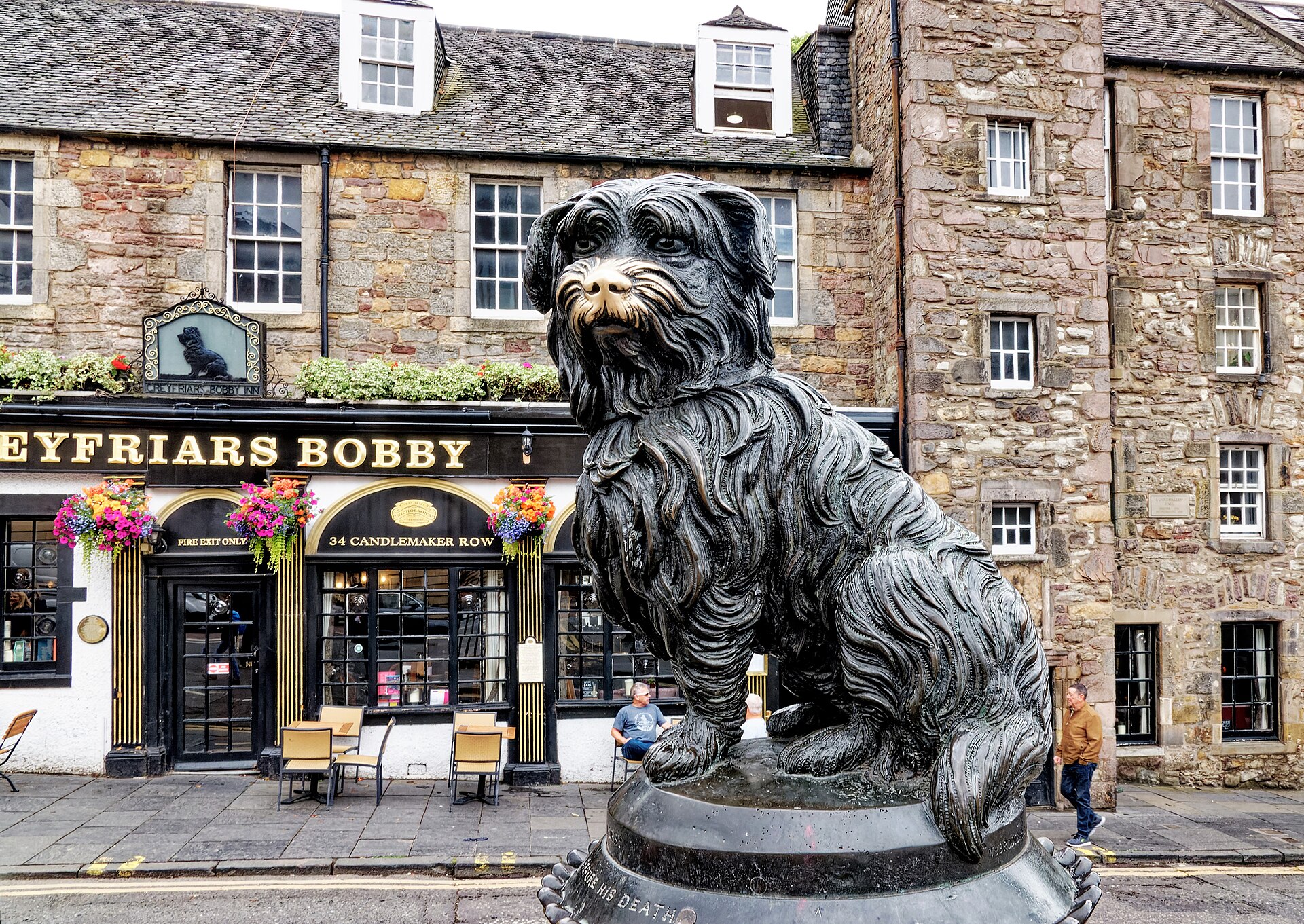
The statue stands at the junction of Candlemaker Row and George IV Bridge, immediately outside Greyfriars Bobby’s Bar. It is approximately 6 feet tall (including its plinth and water fountain). The statue is free to visit at any time.
The famous tradition of rubbing Bobby’s nose for luck has worn the original bronze considerably. After the 2019 restoration, signs ask visitors not to touch the statue (most visitors ignore them). The polished nose remains a marker of the practice, and the Edinburgh City Council has acknowledged that some compromise between conservation and tradition is inevitable.
For the best photos:
Early morning: Almost no other visitors. The bronze catches the morning light beautifully.
Late afternoon: Soft golden light; reasonable foot traffic.
Avoid mid-day in summer: Constant queue of tourists waiting to rub Bobby’s nose.
Greyfriars Kirkyard: The Graveyard
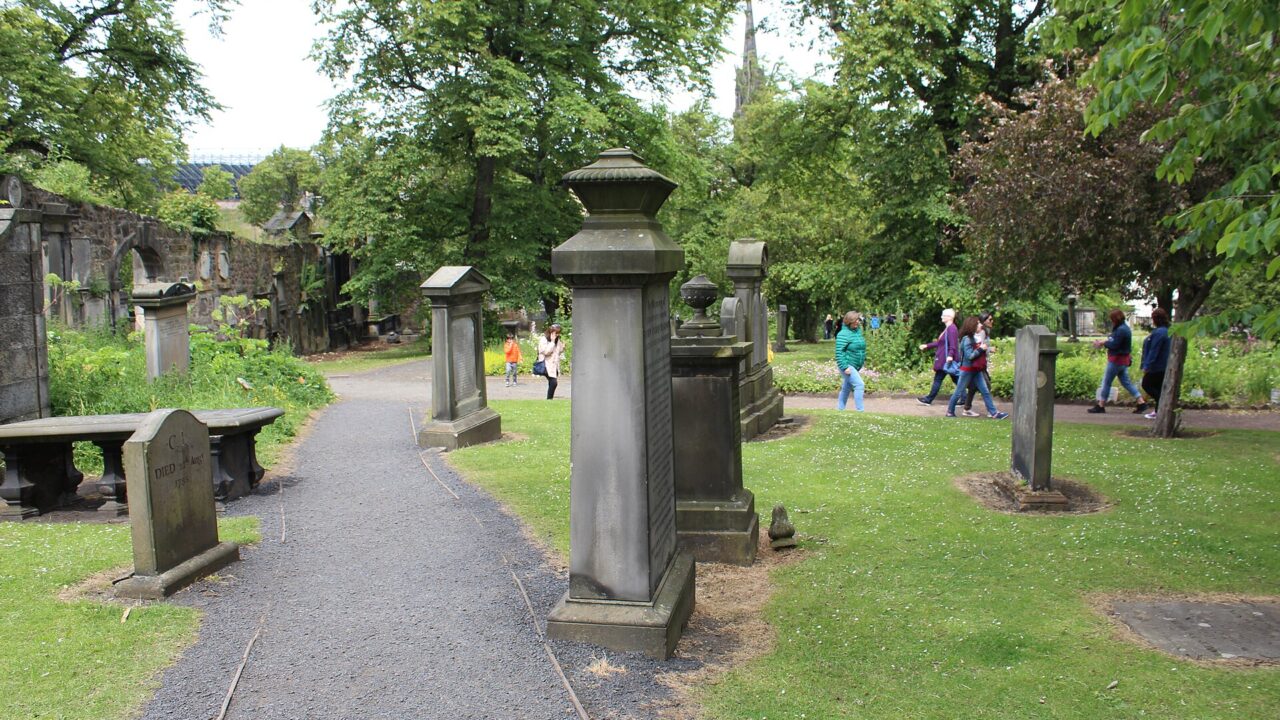
The Greyfriars Bobby story unfolds within the larger context of Greyfriars Kirkyard — one of the most historically dense graveyards in Britain. The kirkyard surrounds Greyfriars Kirk (built 1620) and contains burials dating from the late 16th century onwards. The kirkyard is genuinely, atmospherically beautiful — particularly in autumn, in mist, or after rain.
Major burials and historical landmarks within the kirkyard include:
The Covenanters’ Prison
The southern portion of the kirkyard, separated by a wall and a locked iron gate, was used as an outdoor prison for 1,200 Presbyterian Covenanters in 1679 after the Battle of Bothwell Bridge. Most died from exposure, hunger, or disease. The Covenanters’ Prison is included on certain ghost tours; it is otherwise locked to the public.
The Mackenzie Mausoleum
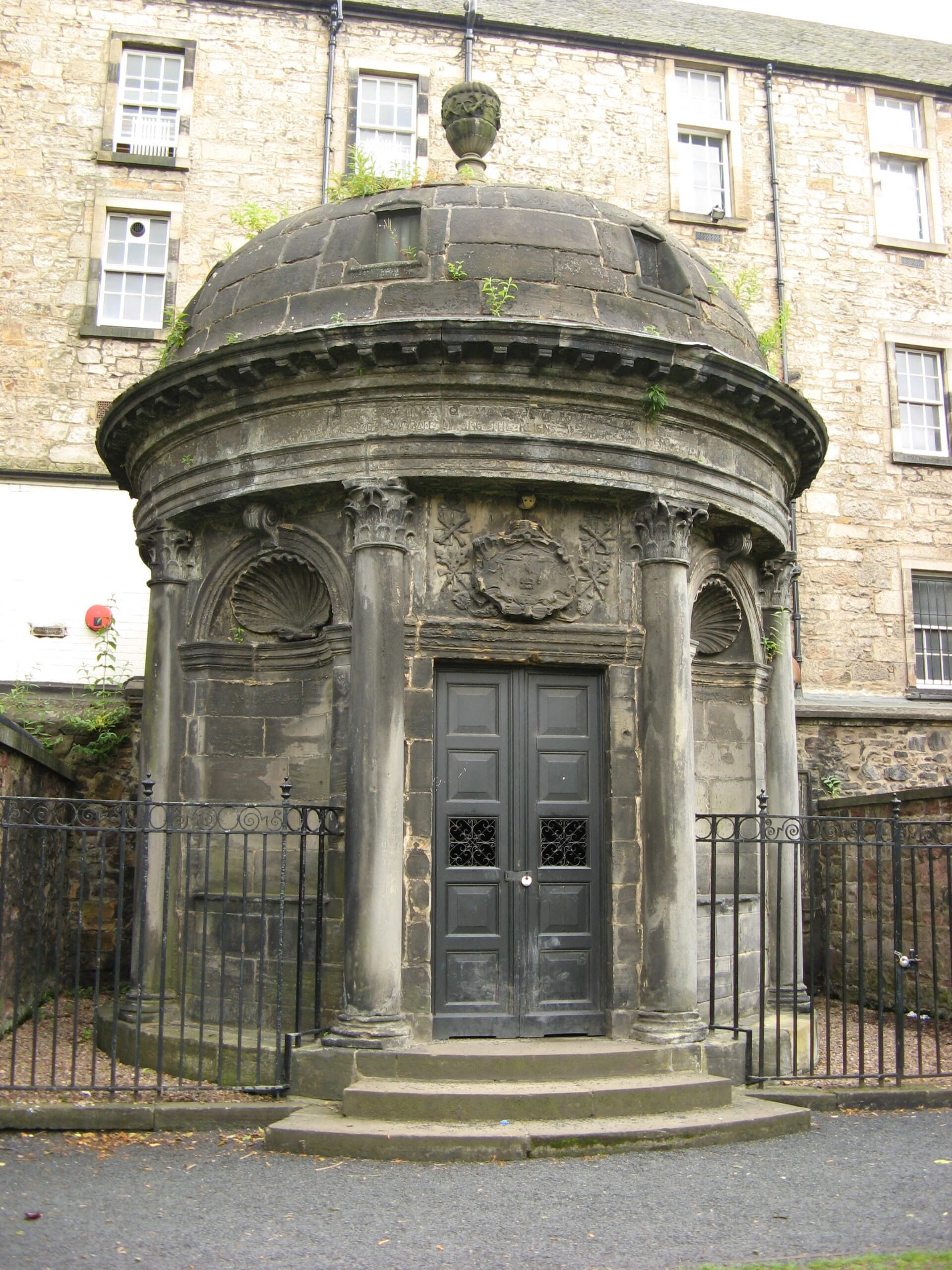
The tomb of Sir George “Bloody” Mackenzie of Rosehaugh (1636-1691), the Lord Advocate of Scotland responsible for the prosecution and torture of many Covenanters. The tomb is a major focus of the Mackenzie Poltergeist activity reported since the 1990s.
“Tom Riddle” Headstone
One of the kirkyard’s headstones bears the name “Thomas Riddle” — and is widely cited as inspiration for the name of Voldemort (born Tom Marvolo Riddle) in the Harry Potter books. J.K. Rowling, who lived in Edinburgh while writing the books, has acknowledged borrowing names from the kirkyard, although the precise inspiration for Tom Riddle has never been definitively confirmed.
Greyfriars Kirk Itself
The kirk (church) at the heart of the kirkyard was built in 1620 — the first new church to be built after the Reformation in Edinburgh. It is the kirk where the National Covenant of 1638 was first signed, an event that triggered the Wars of the Three Kingdoms.
Other Notable Burials
Many of Edinburgh’s most influential 17th-19th century citizens are buried here, including poet Allan Ramsay, philosopher James Beattie, architect James Craig (designer of the New Town), printer William Smellie (publisher of the Encyclopaedia Britannica), and many more.
The Mackenzie Poltergeist
Greyfriars Kirkyard has a strong claim to being the most actively haunted graveyard in the world. The Mackenzie Poltergeist phenomenon began in 1998 when a homeless man broke into the locked Black Mausoleum (Sir George Mackenzie’s tomb) seeking shelter. According to legend, his disturbing of Mackenzie’s remains awakened the spirit.
Since then, hundreds of visitors on ghost tours through the Covenanters’ Prison have reported physical attacks — being pushed, scratched, bitten, knocked unconscious. The City of the Dead Tour, which has exclusive access to the Covenanters’ Prison after dark, has logged over 500 documented “attacks” in 25 years of operation.
The phenomenon has been investigated by paranormal-research groups and television documentaries. Whether or not you believe in poltergeists, the Covenanters’ Prison after dark is genuinely one of the most atmospheric and unsettling places in Britain.
Greyfriars Bobby’s Bar
The pub immediately adjacent to the statue is Greyfriars Bobby’s Bar — a friendly traditional Edinburgh pub with reasonable food, a proper Scottish menu, and obvious Bobby memorabilia. Worth a stop for lunch or a pint after visiting the statue.
Visiting Greyfriars Kirkyard
Opening hours: The kirkyard is open daily, generally from 8am to 5:30pm (later in summer). The Greyfriars Kirk itself has separate opening hours and free admission during these.
Free admission: The kirkyard, the kirk, and the Bobby statue are all free.
Covenanters’ Prison: Locked to the general public; accessible only via licensed ghost tours (City of the Dead Tour, Mercat Tours).
Photography: Permitted throughout. Tripods OK in the kirkyard; less suitable in the kirk during services.
Tours: Multiple operators run guided ghost tours of the kirkyard at night. Standard prices £15-£25.
Accessibility: The kirkyard has uneven cobbles and grass paths; partial wheelchair access. The kirk itself is largely accessible.
Bobby’s Grave
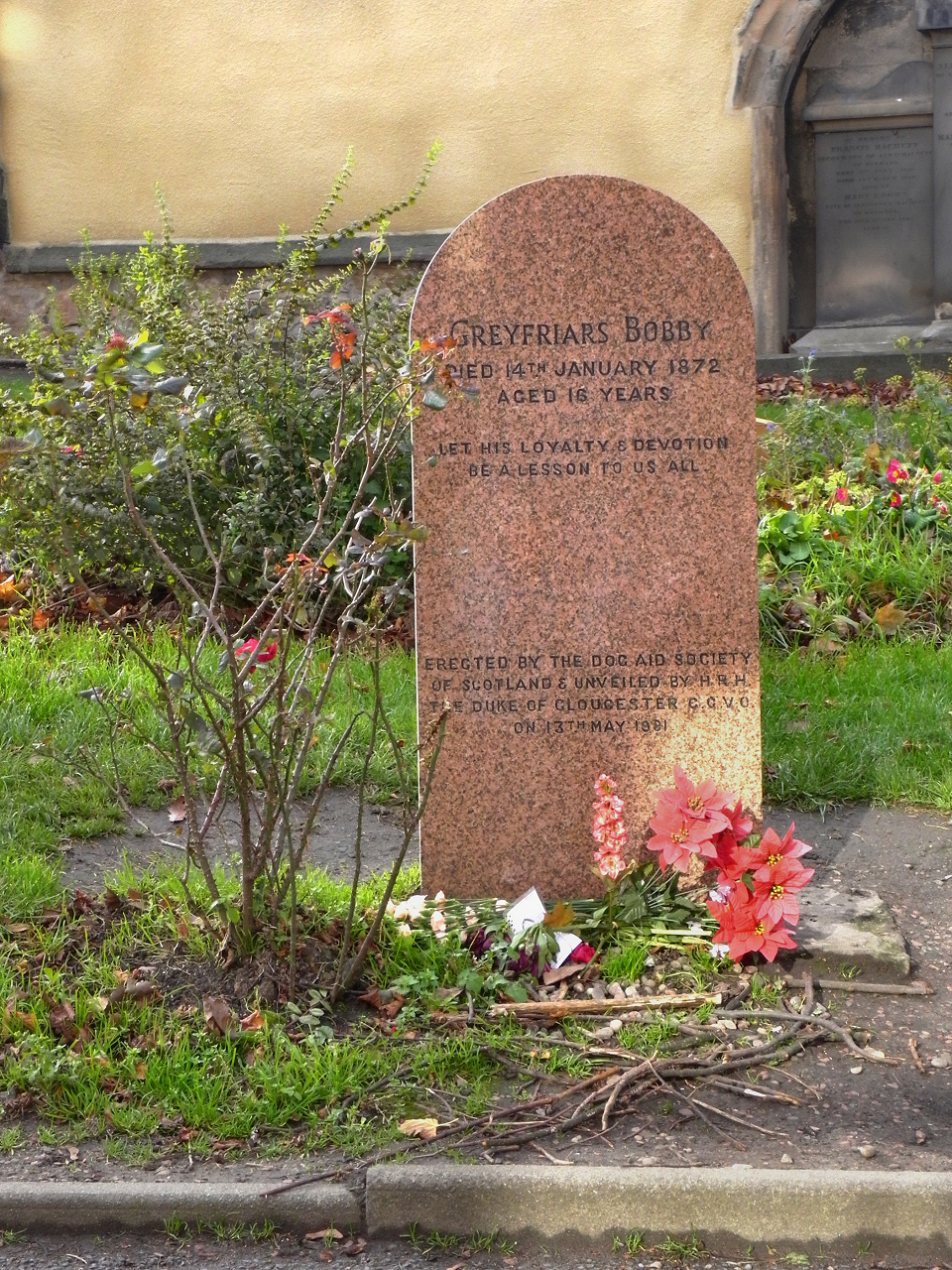
Bobby himself was buried in 1872 just outside the consecrated kirkyard ground (since dogs were not permitted in consecrated soil). A small headstone bears the inscription:
“Greyfriars Bobby — died 14th January 1872 — aged 16 years. Let his loyalty and devotion be a lesson to us all.”
Tourists leave small offerings — flowers, dog biscuits, pebbles — at the grave. The grave is a few metres from John Gray’s gravestone (which is visible in the consecrated ground beyond).
Greyfriars and Harry Potter
J.K. Rowling lived in Edinburgh while writing the Harry Potter books, and several Greyfriars Kirkyard headstones bear names that match Potter characters: Thomas Riddle (Voldemort), William McGonagall (Professor McGonagall — though Rowling has confirmed this name came from a 19th-century Edinburgh poet rather than the kirkyard), and others.
The view of nearby George Heriot’s School from the kirkyard’s eastern edge is often credited as a Hogwarts inspiration. The school’s four towers and Renaissance bulk certainly suggest the imagined Hogwarts profile.
Rowling has acknowledged drawing names from the kirkyard, though the exact list and mechanism of inspiration has never been definitively confirmed.
Sample Greyfriars Visit Itineraries
Quick Visit (30 minutes)
Bobby statue. Quick walk through the kirkyard. Tom Riddle headstone. Out via Candlemaker Row.
Half-Day Walk (3 hours)
Bobby statue. Greyfriars Bobby’s Bar for lunch. Greyfriars Kirk interior. Full kirkyard exploration. Climb Candlemaker Row to the Royal Mile. Visit National Museum of Scotland next door.
Full Old Town Walking Day
9am: Bobby statue. 10am: Kirkyard. 11am: National Museum of Scotland. 12:30pm: Lunch on the Royal Mile. 2pm: Real Mary King’s Close. 4pm: Edinburgh Castle. Total: 8 hours.
Evening Ghost Tour
9pm: Meet for City of the Dead Tour. 9:15pm: Walk through Greyfriars Kirkyard. 9:45pm: Enter the locked Covenanters’ Prison. Tour finishes around 10:30pm. Late drinks at Greyfriars Bobby’s Bar.
Tips for Visiting
Visit early. Bobby’s statue gets crowded mid-day in summer.
Wear good shoes. The kirkyard’s cobbles and grass paths are uneven.
Don’t miss the kirk interior. Free entry during opening hours; rare 1620 Reformation-era kirk.
Combine with the National Museum of Scotland. Free, world-class, immediately next door.
For ghost tours, book the City of the Dead Tour. Exclusive Covenanters’ Prison access; well-regarded.
Don’t rub Bobby’s nose. Conservation requests now ask visitors not to touch the statue. Many ignore this.
Search Tom Riddle’s headstone. Located in the western section of the kirkyard. Several small flowers usually on it.
Frequently Asked Questions
Where is the Greyfriars Bobby statue?
The statue stands at the junction of Candlemaker Row and George IV Bridge, immediately outside Greyfriars Bobby’s Bar. About a 5-minute walk from the Royal Mile and 10 minutes from Edinburgh Castle.
Is Greyfriars Kirkyard free to visit?
Yes. Both the kirkyard and the Greyfriars Bobby statue are free to visit. Greyfriars Kirk also offers free entry during opening hours. The locked Covenanters’ Prison is accessible only via paid guided tours.
Did Greyfriars Bobby really sit by his master’s grave for 14 years?
The traditional story is largely Victorian creation. Modern historical research suggests the original 1858-1867 “Bobby” was probably a stray dog that lingered around the kirkyard for food, and that Victorian sentiment gradually turned the story into the legend we know today. The emotional truth — Edinburgh’s deep affection for the story — remains real.
Is Greyfriars Kirkyard haunted?
The Mackenzie Poltergeist has been reported in the locked Covenanters’ Prison section since 1998, with hundreds of documented “attacks” recorded by the City of the Dead Tour. Whether you believe in poltergeists or not, the kirkyard at night is genuinely atmospheric and unsettling.
Can you visit the Covenanters’ Prison?
Only via licensed guided tours. The City of the Dead Tour has exclusive after-dark access. Standard kirkyard visitors cannot enter the Covenanters’ Prison area.
Is Greyfriars Kirkyard related to Harry Potter?
Several headstones bear names that match Potter characters (Thomas Riddle especially). J.K. Rowling has acknowledged drawing names from Edinburgh sources, though the precise inspiration for individual characters has never been fully confirmed.
How do I find Tom Riddle’s grave at Greyfriars?
The “Thomas Riddle” headstone is in the western section of Greyfriars Kirkyard, broadly south of the kirk. Several worn flowers and small offerings usually mark the grave.
Is Greyfriars Bobby’s Bar a good pub?
Yes. Friendly traditional Edinburgh pub, reasonable Scottish menu, decent ales and whisky. A natural stop after visiting the statue.
What is the best time to visit Greyfriars?
Early morning (8am-9:30am) for the Bobby statue without crowds. Mid-afternoon for the kirkyard. Evening for ghost tours. Autumn (October especially) for the most atmospheric kirkyard experience.
Is Greyfriars wheelchair accessible?
Partially. The Bobby statue is on a step-free pavement. The kirkyard’s cobbles and grass paths are uneven; partial wheelchair access. The kirk is largely accessible.
Final Thoughts
Greyfriars Bobby Edinburgh is more than a small bronze statue — it is a focal point for some of Scotland’s most enduring stories about loyalty, mortality, and the strange power of cultural myth. The surrounding Greyfriars Kirkyard is one of the most historically dense and atmospheric graveyards in Britain. Together, they reward a longer visit than most tourists give them. Allow at least 90 minutes; visit the kirk inside; find Tom Riddle’s headstone; consider the after-dark ghost tour.
For more, see our companion guides on Edinburgh closes and wynds, medieval Edinburgh history, things to do in Edinburgh at night, and the Grassmarket Edinburgh piece (the Grassmarket sits immediately below Greyfriars).
Photo Credits
Paths through Greyfriars Kirkyard: Cimetière Greyfriars Édimbourg 1 by Chabe01, CC BY-SA 4.0, via Wikimedia Commons.
Greyfriars Bobby’s grave: Greyfriars Bobby’s Grave – geograph.org.uk – 2675734 by David Dixon, CC BY-SA 2.0, via Wikimedia Commons.
Greyfriars Bobby statue: +14 Jahre soll Bobby am Grab seines Herren ausgeharrt haben. 04 by Holger Uwe Schmitt, CC BY-SA 4.0, via Wikimedia Commons.
The Mackenzie Mausoleum: Mackenzie mausoleum by Jonathan Oldenbuck, CC BY-SA 3.0, via Wikimedia Commons.